|
VOOZH | about |
|
VOOZH | about |
A tuple is an immutable ordered collection of elements.
A tuple is created by placing all the items inside parentheses (), separated by commas. A tuple can have any number of items.
()
('Geeks', 'For')
(1, 2, 4, 5, 6)
('G', 'e', 'e', 'k', 's')
Tuples can store elements of different data types, such as integers, strings, lists and dictionaries, within a single structure.
(5, 'Welcome', 7.5, True, [1, 2, 3], {'key': 'value'})
We can access the elements of a tuple by using indexing and slicing, similar to how we access elements in a list. Indexing starts at 0 for the first element and goes up to n-1, where n is the number of elements in the tuple. Negative indexing starts from -1 for the last element and goes backward.
G
('e', 'e', 'k')
('G', 'e', 'e')
Geeks
For
Geeks
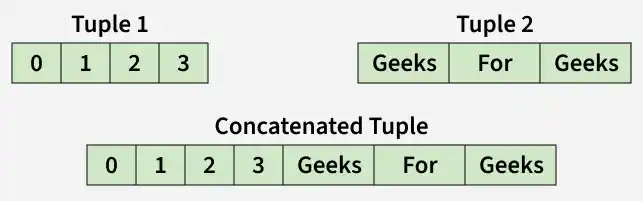
Tuples can be concatenated using the + operator. This operation combines two or more tuples to create a new tuple.
Note: Only tuples can be concatenated with tuples. Combining a tuple with other types like lists will raise an error. Tuples themselves can contain mixed datatypes.
(0, 1, 2, 3, 'Geeks', 'For', 'Geeks')
Slicing a tuple means creating a new tuple from a subset of elements of the original tuple. The slicing syntax is tuple[start:stop:step].
Note: Negative Increment values can also be used to reverse the sequence of Tuples.
('E', 'E', 'K', 'S', 'F', 'O', 'R', 'G', 'E', 'E', 'K', 'S')
('S', 'K', 'E', 'E', 'G', 'R', 'O', 'F', 'S', 'K', 'E', 'E', 'G')
('S', 'F', 'O', 'R', 'G')
Note: [:] returns a new tuple containing all elements of the original tuple. [::step] allows stepping through elements and [::-1] returns the tuple in reverse order.
Since tuples are immutable, we cannot delete individual elements of a tuple. However, we can delete an entire tuple using del statement.
Note: Printing of Tuple after deletion results in an Error.
Output
ERROR!
Traceback (most recent call last):
File "<main.py>", line 6, in <module>
NameError: name 'tup' is not defined
*operator is used in tuple unpacking to grab multiple items into a list. This is useful to extract just a few specific elements and collect the rest together.
1
[2, 3, 4]
5
Explanation: a gets the first item, c gets the last item and *b collects everything in between into a list.