|
VOOZH | about |
|
VOOZH | about |
Variables are used to store data that can be referenced and manipulated during program execution. A variable is essentially a name that is assigned to a value.
5
Alex
To use variables correctly, the following naming rules should be followed:
Below listed variable names are valid:
Below listed variables names are invalid:
1. Basic Assignment: Variables are assigned values using the = operator.
2. Dynamic Typing: Python is dynamically typed, so the same variable can store different data types during execution.
3. Assigning Same Value: same value can be assigned to multiple variables in a single line.
100 100 100
4. Assigning Different Values: Multiple variables can also be assigned different values in a single line.
1 2.5 Python
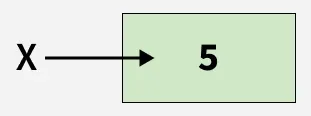
Let us assign a variable x to value 5.
x = 5
When x = 5 is executed, Python creates an object to represent the value 5 and makes x reference this object.
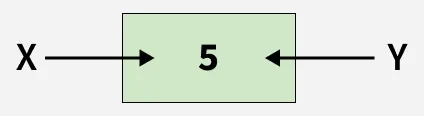
Now, let's assign another variable y to the variable x.
y = x
This statement creates y and references the same object as x, not x itself. This is called a Shared Reference, where multiple variables reference the same object.
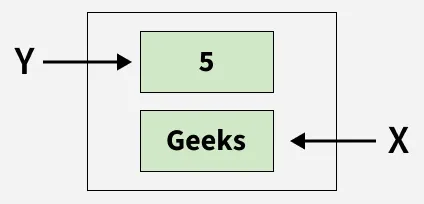
Now, if we write
x = 'Geeks'
Python creates a new object for the value "Geeks" and makes x reference this new object.
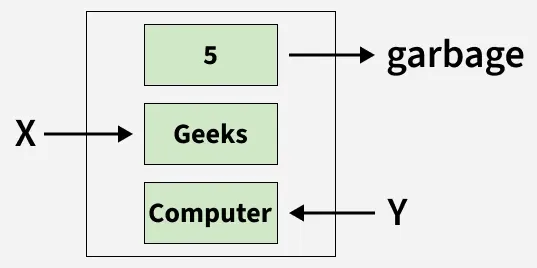
The variable y remains unchanged, still referencing the original object 5. Now, If we assign a new value to y:
y = "Computer"
Python variables store references to objects, not the actual values themselves. When a variable is reassigned, it starts referencing a new object while the old unreferenced object becomes eligible for garbage collection.
In this example, we check whether modifying one variable affects another when both initially reference the same object.
1 2
Explanation:
del keyword is used to delete a variable from memory. After deletion, the variable can no longer be accessed.
Output
ERROR!
Traceback (most recent call last):
File "<main.py>", line 3, in <module>
NameError: name 'x' is not defined
Explanation: del x deletes the variable x. Accessing x after deletion raises a NameError because the variable no longer exists.
1. Swapping Two Variables: Using multiple assignments, we can swap the values of two variables without needing a temporary variable.
10 5
2. Counting Characters in a String: Assign the results of multiple operations on a string to variables in one line.
Length of the word: 6