|
VOOZH | about |
|
VOOZH | about |
PyTorch is an open-source deep learning framework designed to simplify the process of building neural networks and machine learning models. With its dynamic computation graph, it allows developers to modify the network’s behaviour in real-time.
To start using PyTorch, you first need to install it. You can install it via pip:
pip install torch torchvision
For GPU support (if you have a CUDA-enabled GPU), install the appropriate version:
pip install torch torchvision torchaudio cudatoolkit=11.3
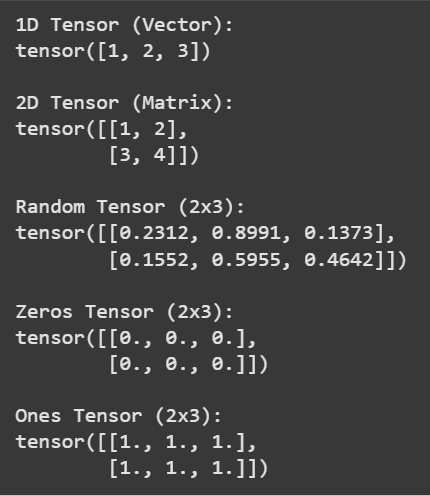
A tensor is a multi-dimensional array that is the fundamental data structure used in PyTorch. We can create tensors for performing above in several ways:
Output:
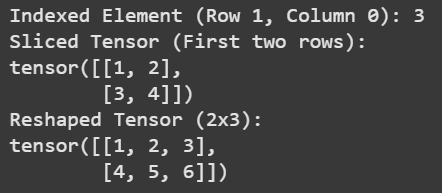
PyTorch operations are essential for manipulating data efficiently, especially when preparing data for machine learning tasks.
Let's understand these operations with help of simple implementation:
Output:
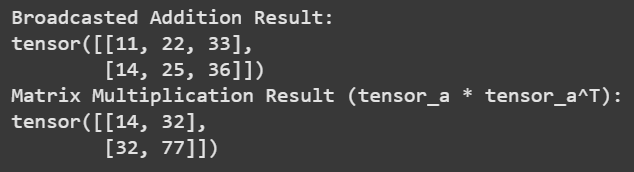
PyTorch offers a variety of common tensor functions that simplify complex operations.
Output:
PyTorch facilitates GPU acceleration, enabling much faster computations which is especially important in deep learning due to the extensive matrix operations involved. By transferring tensors to the GPU, you can significantly reduce training times and improve performance.
Output:
In this section, we'll implement a neural network using PyTorch, following these steps:
In this step, we’ll define a class that inherits from torch.nn.Module. We’ll create a simple neural network with an input layer, a hidden layer and an output layer.
Next, we’ll prepare our data. We will use a simple dataset that represents the XOR logic gate, consisting of binary input pairs and their corresponding XOR results.
Now we will instantiate our model. We’ll also define a loss function and choose an optimizer like stochastic gradient descent to update the model’s weights based on the calculated loss.
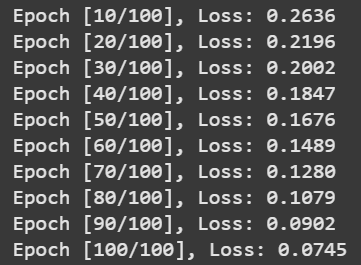
Now we enter the training loop, where we will repeatedly pass our training data through the model to learn from it.
Output:
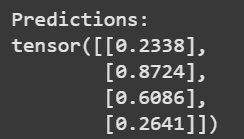
Finally, we need to evaluate the model’s performance on new data to assess its generalization capability.
Output:
Dataset and DataLoader facilitates batch processing and shuffling, ensuring smooth data iteration during training.
Torchvision provides simple tools for applying random transformations such as rotations, flips and scaling hence enhancing the model's ability to generalize on unseen data.
Batch processing improves computational efficiency and accelerates training, especially on hardware accelerators.
PyTorch makes it easy to construct Generative Models, including: