|
VOOZH | about |
|
VOOZH | about |
Prerequisites: Know about Cyclic redundancy, Socket Programming
What is CRC?
CRC or Cyclic Redundancy Check is a method of detecting accidental changes/errors in the communication channel.
CRC uses Generator Polynomial which is available on both sender and receiver sides. An example generator polynomial is of the form of x^3 + 1. This generator polynomial represents key 1001. Another example is x^2 + x. that represents key 110.
Example:
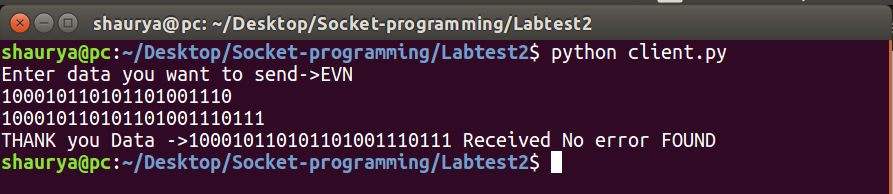
Let data send is "EVN"
We convert a string to binary string data.
100010110101101001110
CRC KEY: 1001
Code: CRC key length -1 -> 000 appended at end of data.
New data: 100010110101101001110000
Key:1001
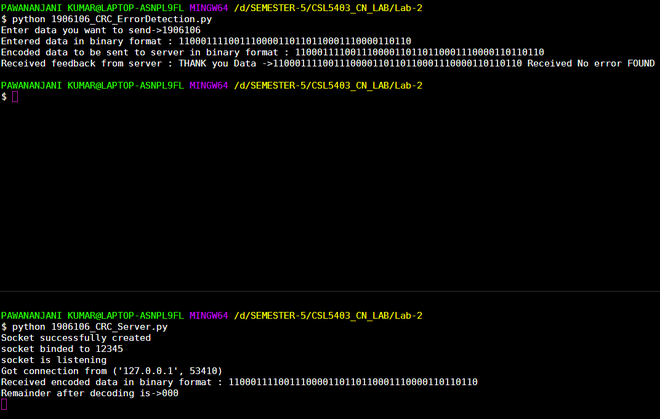
Now we apply CRC in socket programming python at both sender and receiver sides.
Sender Side
1. The task is to send string data to the server/receiver side.
2. The sender sends a string let us say "EVN".
3. First, this string is converted to binary string "100010110101101001110" key is known to both the side sender and receiver here key used is 1001.
4. This data is encoded using the CRC code using the key on the client/sender side.
5. This encoded data is sent to the receiver.
6. Receiver later decodes the encoded data string to verify whether there was any error or not.
Receiver Side
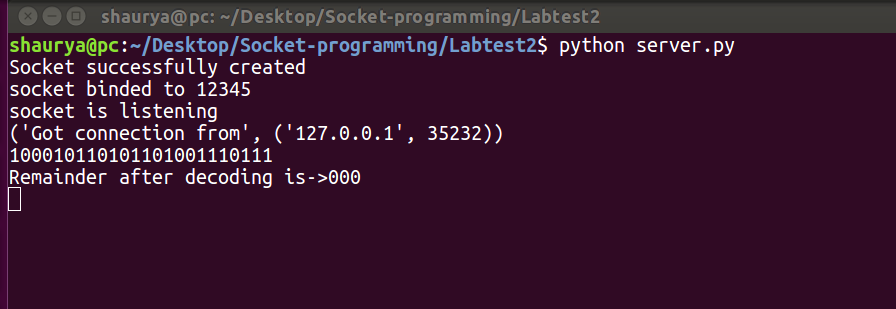
1. The receiver receives the encoded data string from the sender.
2. Receiver with the help of the key decodes the data and finds out the remainder.
3. If the remainder is zero then it means there is no error in data sent by the sender to the receiver.
4. If the remainder comes out to be non-zero it means there was an error, a Negative Acknowledgement is sent to the sender. The sender then resends the data until the receiver receives the correct data.