|
VOOZH | about |
|
VOOZH | about |
In this article, we are going to create a sequence of linearly increasing values with Numpy arrange() function.
By using arrange() function, we can create a sequence of linearly increasing values. This method returns an array with evenly spaced elements as per the interval. The interval mentioned is half opened i.e. [Start, Stop)
Syntax:
numpy.arrange(start, stop, step)Parameters:
- start is the starting value
- stop is the ending value
- step is a linear increment value with in the given range. It is optional. By default, it is 1.
Return Type:
- Return an array of elements
For example:
numpy.arrange(1,10,3) # array([1,4,7])
Here, we have given a range from 1 to 10(start = 1 and stop = 10) but we specified step=3. That means it skips every 3 elements in a range. So In this way, we can increase linearity in data.
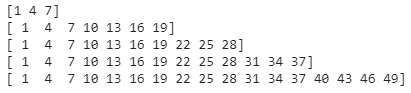
Example 1:
Create elements within range with 3-step linearly.
Output:
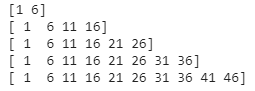
Example 2:
Create elements within range with 5-step linearly.
Output:
Example 3:
Create elements within the range of 34 to 50 with 5-step linearly.
Output:
[34 39 44 49]