|
VOOZH | about |
|
VOOZH | about |
Without permission, disconnecting a device from a Wi-Fi network is against the law and immoral. Sometimes, you might need to check your network's security or address network problems. You may send a de-authentication packet to disconnect devices from Wi-Fi using Scapy, a potent Python packet manipulation module. This tutorial will look at utilizing Python's Scapy to disconnect devices from Wi-Fi.
In Wi-Fi networks, a de-authentication packet is a management frame that cuts off a client device from an access point. When a client device joins a Wi-Fi network, it periodically transmits "beacon" frames to the access point to keep the connection going. To verify the connection, the access point, in turn, transmits "probe response" packets to the client device. A client device disconnects from the Wi-Fi network when a de-authentication packet is issued, simulating an unlawful disconnect.
Installing Scapy
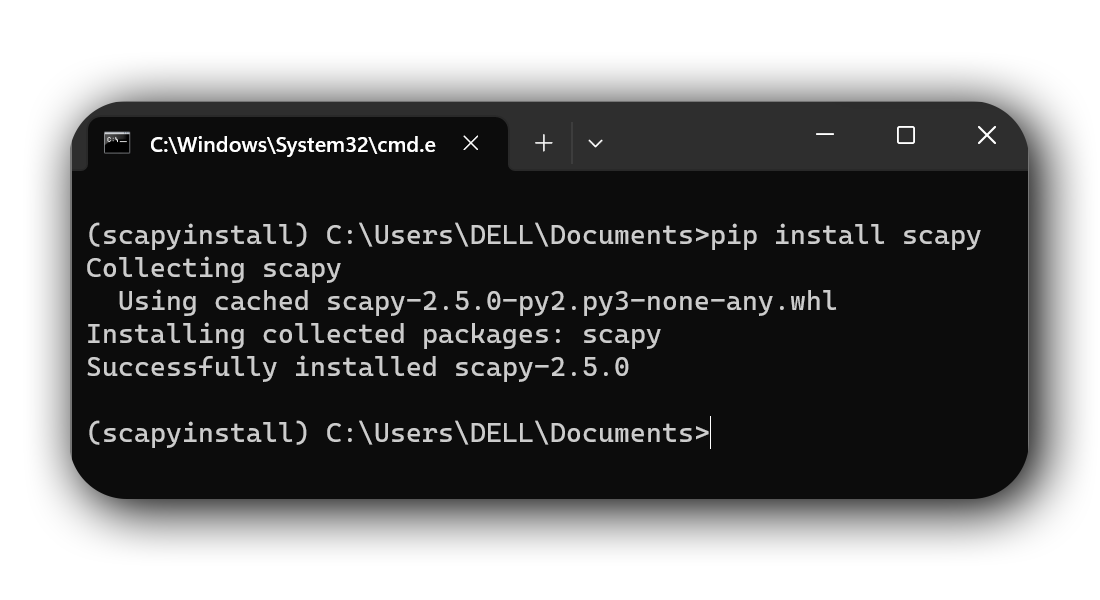
Installing Scapy is necessary before we can use it to send de-authentication packets. The Python package installer, pip, may be used to set up Scapy. Run the following command in a terminal or command prompt:
pip install scapy
Installing Npcap
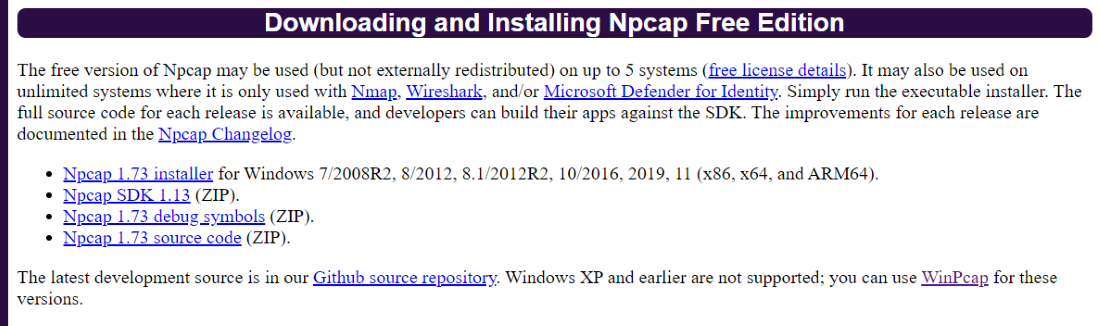
Besides Scapy, You need to install Npcap, which is used for packet capture (and sending). You can download Npcap here:- https://npcap.com/#download
disconnect_user(mac_address, access_point, interface)
This function sends de-authentication packets to the MAC address of the target device. The "interface" parameter uses the network interface's name for transmitting the de-authentication frames. At the same time, the "mac_address" and "access_point" arguments specify the MAC addresses of the access point and the target device, respectively. The function builds the de-authentication packet using the "RadioTap" and "Dot11Deauth" classes from the Scapy library. Then it sends the packets using the "sendp" function.
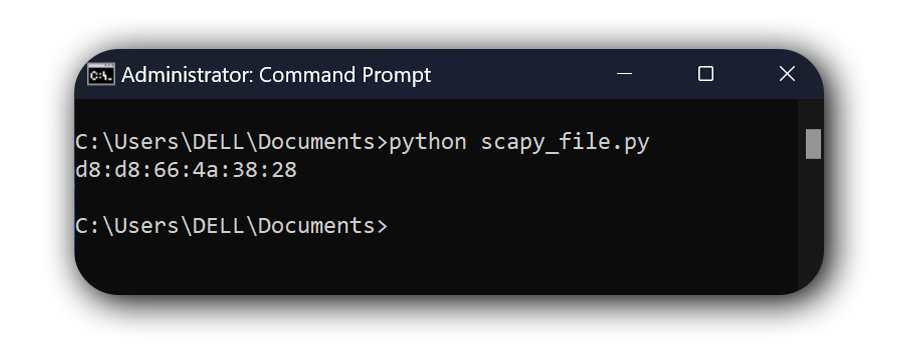
get_mac_address(ip_address)
This method sends an ARP request to the given IP address. The "ip_address" parameter represents the IP address to submit the ARP request. The "sr1" function is used to transmit the packet and receive the ARP response, while the "ARP" class from the Scapy library is used to build the ARP request packet. The function returns the related MAC address if an ARP response is received; else, it returns " None."
Output:
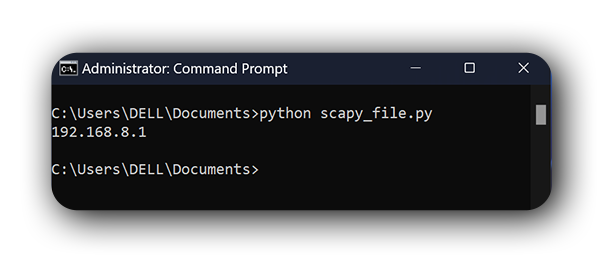
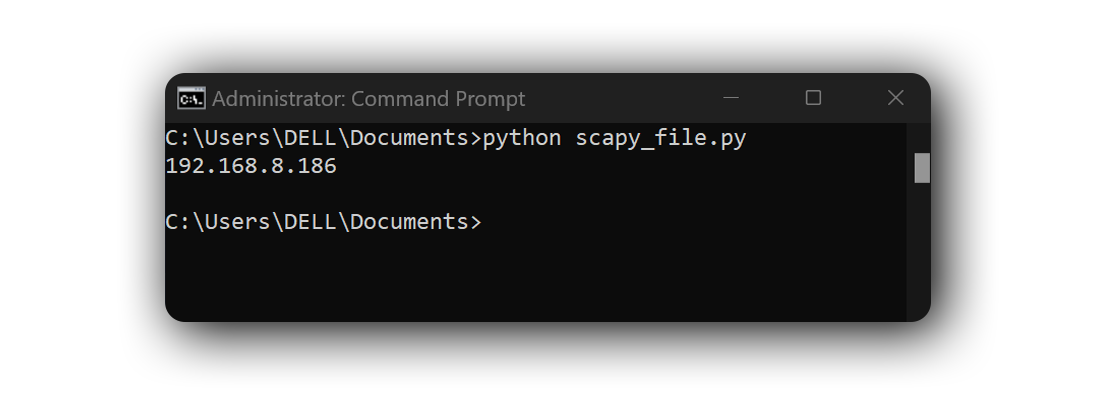
getting_ip_of_access_point()
This function returns the IP address of the default gateway or access point. The function uses the "conf.route.route" method from the Scapy library to get the routing details for the IP address "8.8.8.8". The IP address of the gateway or access point is then returned using the routing data.
Output:
getting_ip_of_this_device()
This function returns the current device's IP address. The function uses "conf.route.route" method from the Scapy library to get the routing details for the IP address "8.8.8.8". The current device's IP address is then returned from the routing data.
Output:
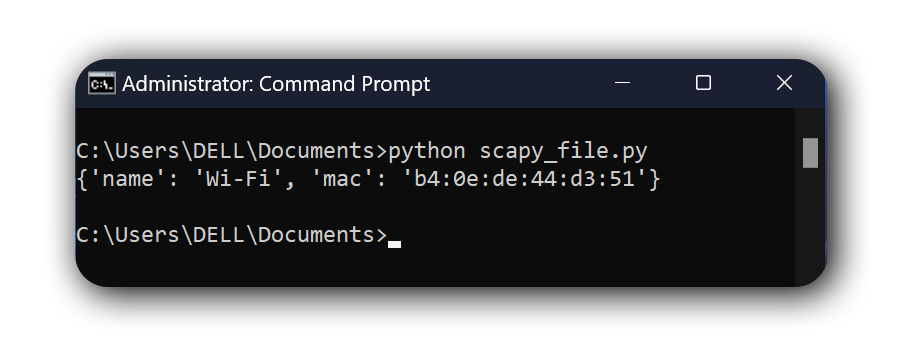
getting_interface(ip_address)
This Function returns the name and MAC address of the network interface connected to the given IP address using a dictionary. The IP address for which the accompanying network interface data should be obtained is given by the "ip_address" parameter. The function uses the Scapy library's "faces" dictionary to get network interface data for every network interface. The IP addresses of each network interface are then compared to the given IP address as the program loops through the network interfaces. The function returns a dictionary with the name and MAC address of the matched network interface if a match is discovered.
Output:
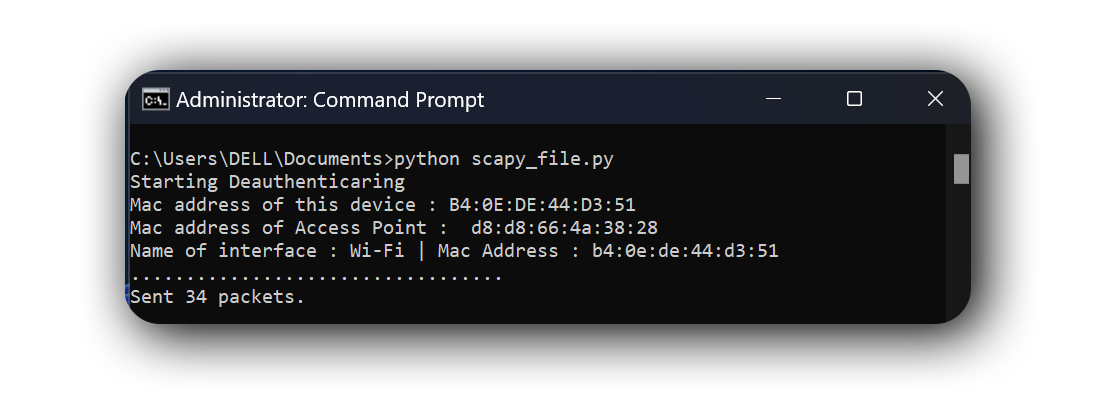
Complete Code
There are a few reasons why a device might not disconnect even when a piece of code occasionally functions correctly: