 |
VOOZH | about |
|
VOOZH | about |
In Python, PyVista is a powerful library for 3D visualization and mesh analysis. It integrates seamlessly with NumPy and provides a robust set of tools for creating interactive plots, mesh generation, and advanced visualization techniques. PyVista's Plotter class offers a versatile environment to create, customize, and interact with 3D plots, making it ideal for scientific computing, geospatial analysis, and engineering simulations.
Its intuitive interface and rich feature set make it a go-to choice for visualizing complex data structures and meshes in Python. let's see the steps to use PyVista Plotter for 3D Visualization:
Import the PyVista library in your Python script or interactive session.
import pyvista as pvInstantiate a pyvista.Plotter() object. This object serves as the canvas for rendering 3D plots.
If you have data to visualize, load it into PyVista's data structures such as pyvista.PolyData, pyvista.StructuredGrid, or pyvista.UnstructuredGrid.
Add the loaded data (if any) to the plotter using methods like .add_mesh() or .add_points(), depending on the type of data.
Finally, call the plotter's .show() method to display the 3D plot interactively or .render() method to generate a static image.
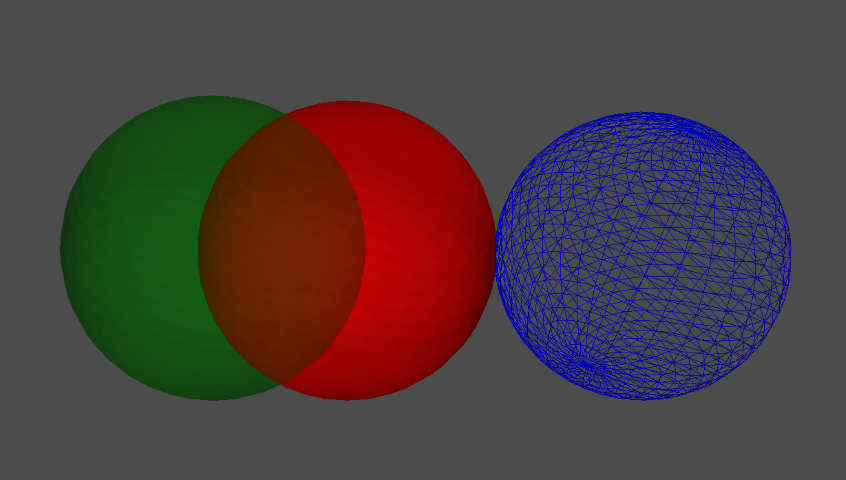
In this example, we are performing 3D visualization using PyVista. Three spheres of different sizes, colors, and rendering styles (solid red, blue wireframe, and semi-transparent green) are added to a plotter instance and displayed interactively using plotter.show().
Output
In this example, PyVista Plotter is utilized to visualize a 3D scene comprising a blue cone, a red sphere with visible edges, a green wireframe plane positioned below the origin, and a yellow wireframe cylinder. Each shape is added to the plot using add_mesh with specified colors, opacities, and rendering styles.
Output
In conclusion, PyVista's Plotter provides a robust framework for creating interactive 3D visualizations in Python. With seamless integration with NumPy and support for various mesh types and advanced rendering techniques, PyVista empowers users in scientific computing, geospatial analysis, and engineering simulations to explore and visualize complex data structures with ease and precision.

.png)