|
VOOZH | about |
|
VOOZH | about |
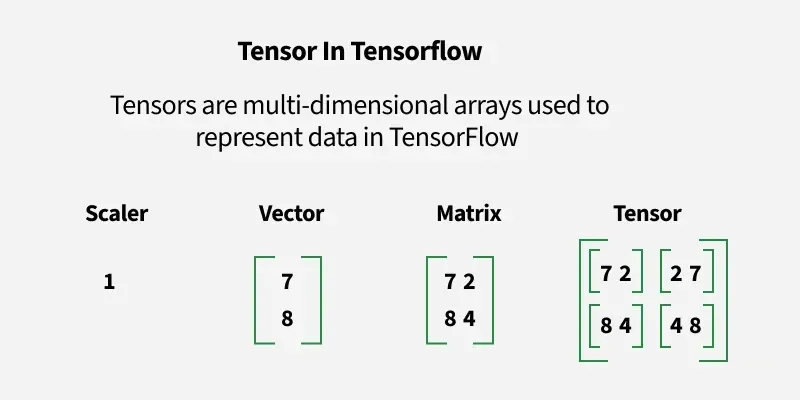
Tensor is a multi-dimensional array used to store data in machine learning and deep learning frameworks such as TensorFlow. Tensors are the fundamental data structure in TensorFlow and they represent the flow of data through a computation graph. Tensors generalize scalars, vectors and matrices to higher dimensions.
Tensors in TensorFlow can take various forms depending on their number of dimensions.
Higher-dimensional tensors: Tensors with more than three dimensions are often used to represent more complex data, such as color images (which might be represented as a 4D tensor with shape [batch_size, height, width, channels]).
TensorFlow framework is designed for high-performance numerical computation, operates primarily using tensors. When you use TensorFlow, you define your model, train it and perform operations using tensors.
A tensor in TensorFlow is represented as an object that has:
TensorFlow provides a variety of operations that can be applied to tensors, including mathematical operations, transformations and reshaping.
TensorFlow provides a large set of tensor operations, allowing for efficient manipulation of data. Below are some of the most commonly used tensor operations in TensorFlow:
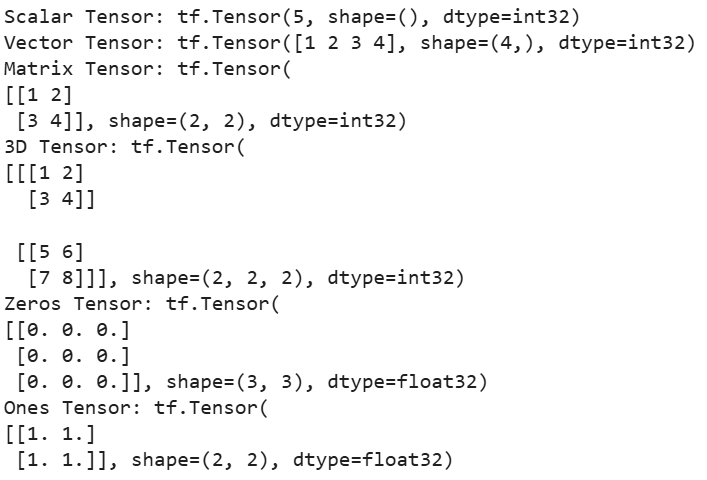
You can create tensors using TensorFlow’s tf.Tensor() or its various helper functions, such as tf.constant(), tf.Variable() or tf.zeros():
Output:
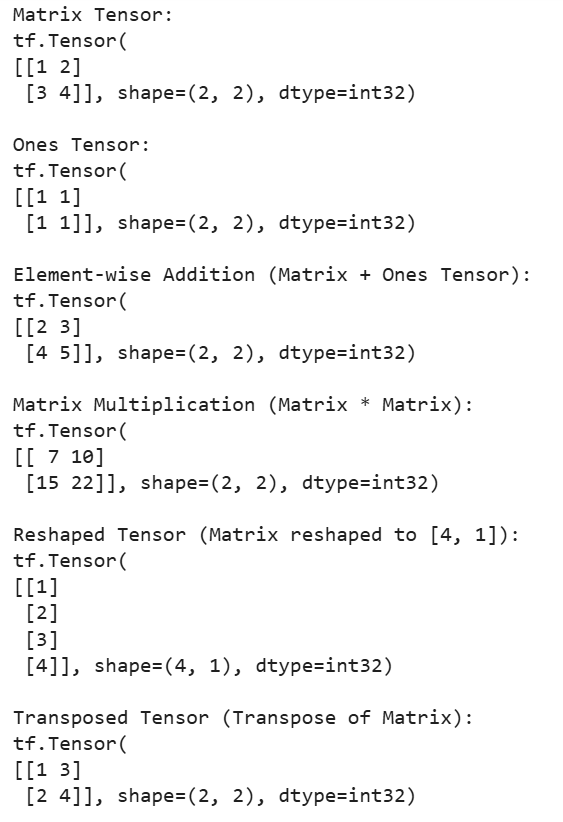
TensorFlow supports various operations that can be performed on tensors, such as element-wise operations, matrix multiplication, reshaping and more.
Output:
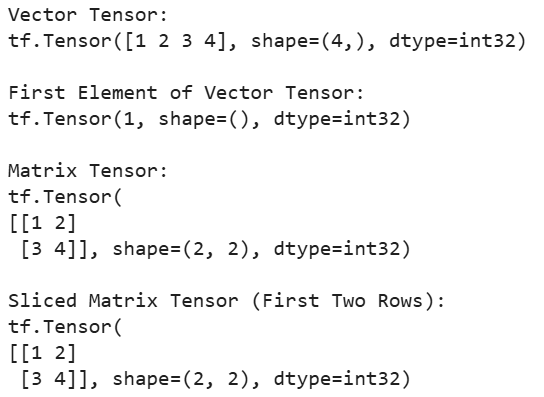
You can access specific elements within a tensor using indices. Similar to how you access elements in Python lists or NumPy arrays, TensorFlow provides slicing and indexing operations.
Output:
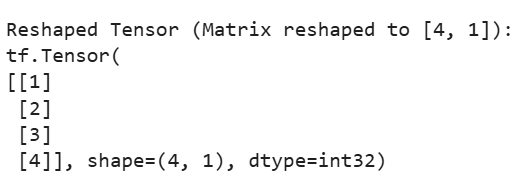
You can change the shape of a tensor by reshaping it. This is often used when you need to feed data into a model with specific input dimensions.
Output:
In neural networks, tensors represent various forms of data throughout the model’s architecture. For example:
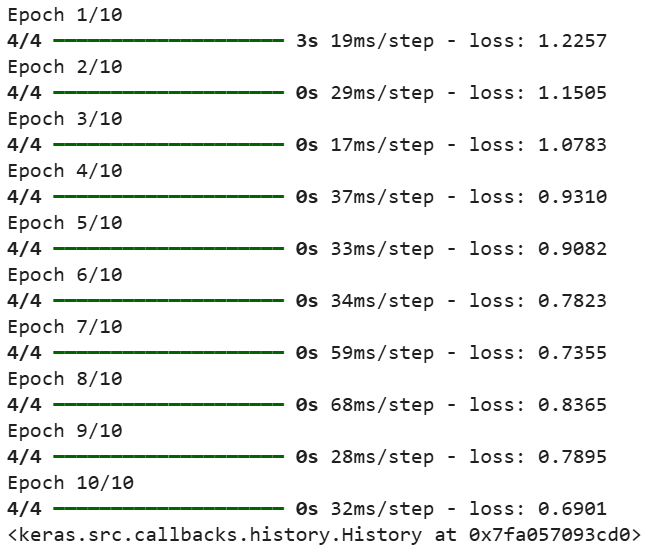
In this example:
Output: