|
VOOZH | about |
|
VOOZH | about |
Measuring similarity between datasets is a fundamental problem in many fields, such as natural language processing, machine learning, and recommendation systems. One of the simplest and most effective similarity measures is Jaccard similarity, which quantifies how much two sets overlap.
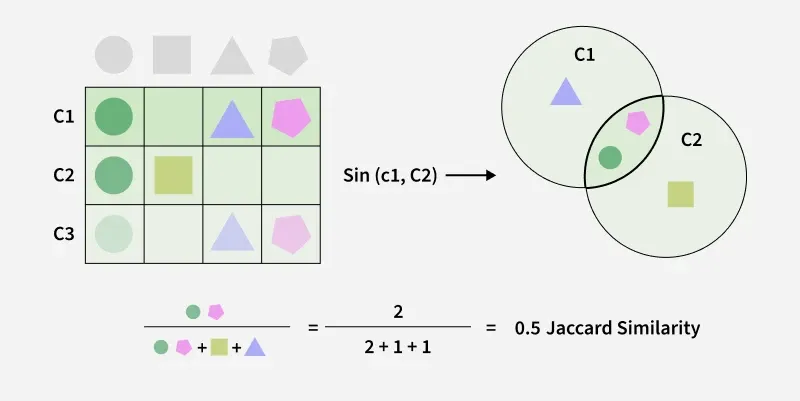
Jaccard similarity, also known as the Jaccard index or Jaccard coefficient, is a measure of similarity between two sets. It is defined as the ratio of the intersection of the sets to their union:
where:
The value of Jaccard similarity ranges from 0 to 1:
For two binary vectors, Jaccard similarity is computed as:
where:
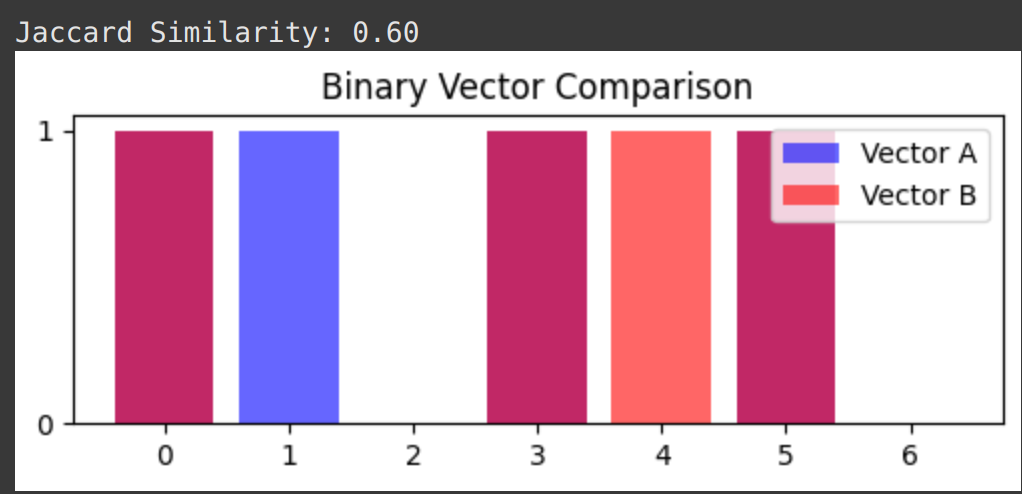
Consider the binary vectors:
A = [1, 1, 0, 1, 0, 1, 0]
B = [1, 0, 0, 1, 1, 1, 0]
Step-by-step calculations:
For two sets 𝐴 and 𝐵, the Jaccard similarity is:
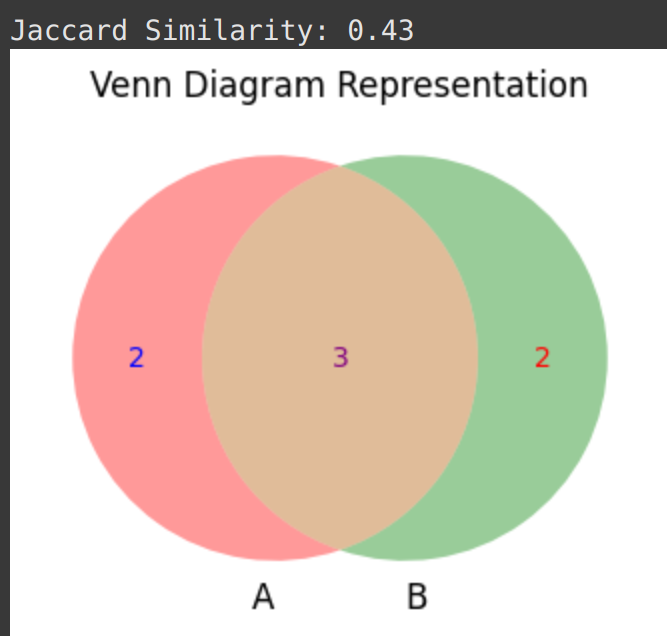
Consider the binary vectors:
A = {1, 2, 3, 4, 5}
𝐵 = {3, 4, 5, 6, 7}
Step-by-step calculations:
1. Text Similarity & Plagiarism Detection: Jaccard similarity is used to compare sets of words or n-grams in two documents. A high similarity score may indicate plagiarism or duplicate content.
2. Recommendation Systems: In collaborative filtering, Jaccard similarity is used to find users with similar preferences by comparing their liked items.
3. Image Processing: In object detection, Jaccard similarity (also called Intersection over Union (IoU)) measures how much a detected object overlaps with the ground truth.
4. Genomic Data Comparison: Jaccard similarity helps compare DNA or protein sequences in bioinformatics.
How to calculate Jaccard Similarity in R
How to calculate Jaccard Similarity in Python
Cosine similarity