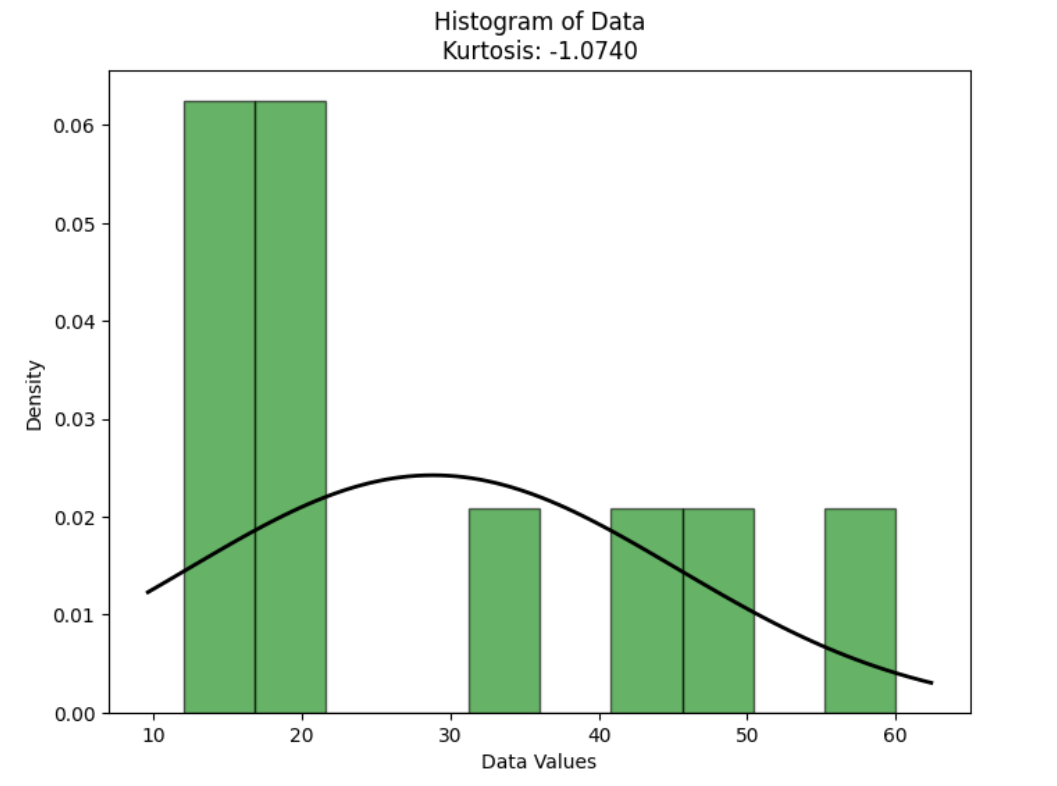
In statistics, kurtosis measures the tailedness of a probability distribution. It helps us understand whether the data have heavy tails, light tails or are normally distributed. Based on kurtosis, distributions can be classified into three types:
Leptokurtic (Kurtosis > 3)
Mesokurtic (Kurtosis ≈ 3, like the Normal Distribution)
Platykurtic (Kurtosis < 3)
Among these, leptokurtic distributions are of particular interest in various fields like finance, risk management and quality control due to their potential to capture extreme values.
What is a Leptokurtic Distribution?
A leptokurtic distribution is characterized by:
High kurtosis: The kurtosis value exceeds 3.
Heavy tails: The distribution has fatter tails compared to a normal distribution.
Sharper peak: A leptokurtic distribution exhibits a more pronounced peak near the mean.
In simpler terms, leptokurtic distributions indicate that data are prone to producing extreme outliers or rare events more frequently than a normal distribution.