|
VOOZH | about |
|
VOOZH | about |
For more complex decision trees, Python allows for nested if statements where one if statement is placed inside another. This article will explore the concept of nested if statements in Python, providing clarity on how to use them effectively.
A nested if statement in Python is an if statement located within another if or else clause. This nesting can continue with multiple layers, allowing programmers to evaluate multiple conditions sequentially. It's particularly useful in scenarios where multiple criteria need to be checked before taking an action.
Let’s consider a practical example to understand how nested if statements work in Python.
Ticket price is $12.
In this example, the outer if checks the age, while the inner if checks the membership status to determine the ticket price.
The basic syntax of a nested if statement in Python is as follows:
if condition1:
# Code to execute if condition1 is true
if condition2:
# Code to execute if both condition1 and condition2 are true
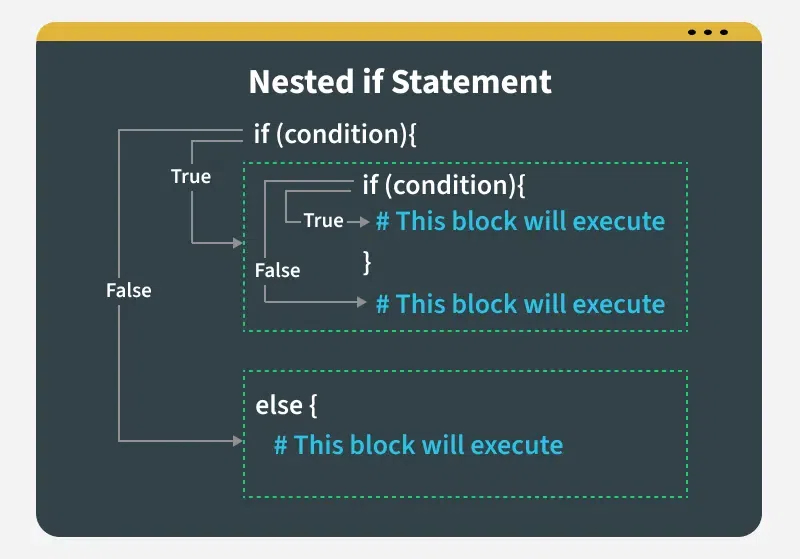
The flowchart illustrates the concept of a nested if statement in programming.
Here’s a summarized explanation of its structure:
if statement evaluates a primary condition.if statement nested inside.if statement checks an additional condition.if condition is false, the flow moves to the else block.else block contains its own set of operations that execute when the primary condition fails.Nested if statements with else conditions are especially useful when decisions require more than one criterion to be evaluated in a sequence. This structure allows developers to refine the decision process at each level, managing specific actions based on various conditions.
Zero