numpy.arcsinh() : This mathematical function helps user to calculate inverse hyperbolic sine, element-wise for all arr.
Syntax : numpy.arcsinh(arr, /, out=None, *, where=True, casting='same_kind', order='K', dtype=None, ufunc 'arcsinh')
Parameters :
arr : array_like
Input array.
out : [ndarray, optional] A location into which the result is stored.
-> If provided, it must have a shape that the inputs broadcast to.
-> If not provided or None, a freshly-allocated array is returned.
where : array_like, optional
Values of True indicate to calculate the ufunc at that position, values of False indicate to leave the value in the output alone.
**kwargs :Allows to pass keyword variable length of argument to a function. Used when we want to handle named argument in a function.
Return : An array with inverse hyperbolic sine of arr
for all arr i.e. array elements.
Note :
2pi Radians = 360 degrees
The convention is to return the angle of arr whose imaginary part lies in [-pi/2, pi/2].
Code #1 : Working
Output :
Input array :
 [2, 1, 10, 100]

Inverse hyperbolic sine values of input array :
 [ 1.44363548 0.88137359 2.99822295 5.29834237]
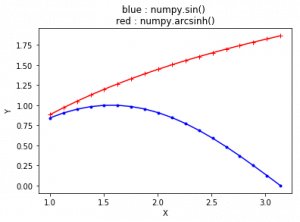
Code #2 : Graphical representation