|
VOOZH | about |
|
VOOZH | about |
A Uniform Distribution is used when every value in a given range has an equal probability of occurring. NumPy provides the numpy.random.uniform() method to generate such values for simulations, sampling, and numerical experiments.
Example: Here’s the example demonstrating how to generate one random value from a Uniform Distribution.
0.6869717010984568
Explanation: This generates a random floating-point number between 0 and 1, the default uniform range.
numpy.random.uniform(low=0.0, high=1.0, size=None)
Parameters:
Example 1: This example shows how to generate five random numbers between 0 and 1 multiple uniform distribution values.
[0.11403523 0.69111039 0.92330809 0.65533514 0.6227924 ]
Explanation: np.random.uniform(size=5) creates an array of 5 random numbers in the range [0, 1).
Example 2: In this example, we generate five random numbers in the range 10 to 20 using the numpy.random.uniform() method.
[15.33364215 15.62793284 19.66237254 18.56727821 11.27919983]
Explanation: This creates an array vals with 5 values sampled uniformly from the interval 10 ≤ x < 20 using np.random.uniform(10, 20, size=5).
NumPy now recommends using the Generator class for random number generation instead of the legacy numpy.random functions. The Generator provides better randomness, reproducibility, and performance. You can create a Generator instance using np.random.default_rng() and then use its .uniform() method to generate uniform random numbers.
Example: Here, we generate a 2×3 matrix where each value comes from the Uniform Distribution between 1 and 5 using Generator.
[[4.42554691 4.11402029 2.90202497]
 [4.74049492 3.26084455 2.00333856]]
Explanation: The rng.uniform(1, 5, size=(2, 3)) call generates a 2×3 array where each value is drawn uniformly from 1 ≤ x < 5.
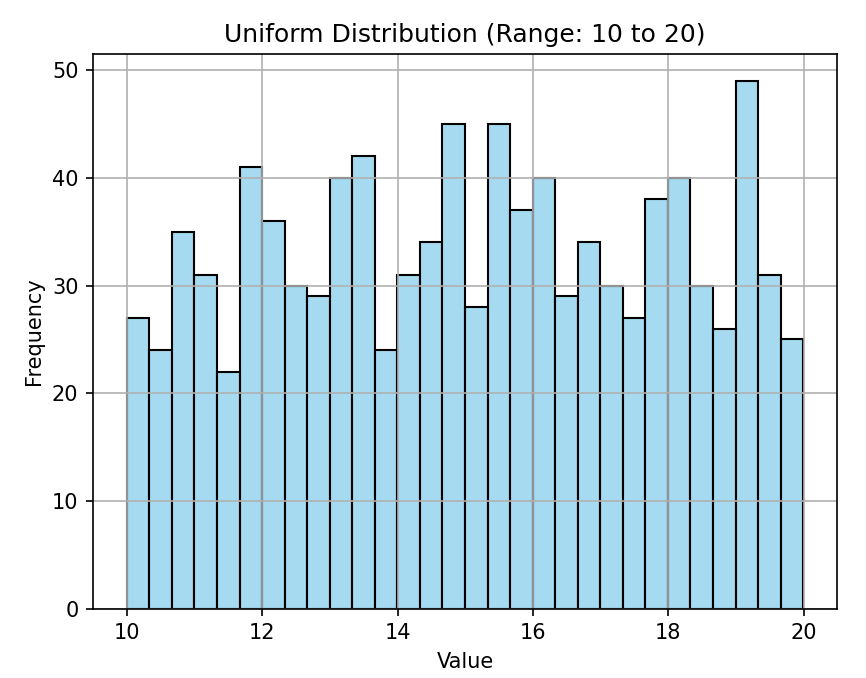
Visualizing the generated numbers helps in understanding their behavior. Let's see a example to plot a histogram of random numbers using numpy.random.uniform function.
Output
Explanation: