|
VOOZH | about |
|
VOOZH | about |
Pedestrian Detection is a computer vision technique used to identify and locate people in images or video streams. It is widely used in applications such as autonomous vehicles, surveillance systems, and traffic monitoring.
OpenCV provides a pre-trained HOG (Histogram of Oriented Gradients) and SVM (Support Vector Machine) model that enables pedestrian detection without requiring custom model training.
Histogram of Oriented Gradients (HOG) is a feature extraction technique commonly used for object detection. It analyzes gradient patterns in an image to capture the shape and structural characteristics of objects, making it particularly effective for pedestrian detection.
OpenCV provides a pre-trained HOG and SVM detector that can be used to detect pedestrians in both images and videos. The following examples demonstrate pedestrian detection in an image and a video stream.
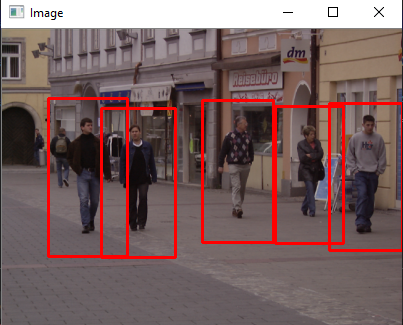
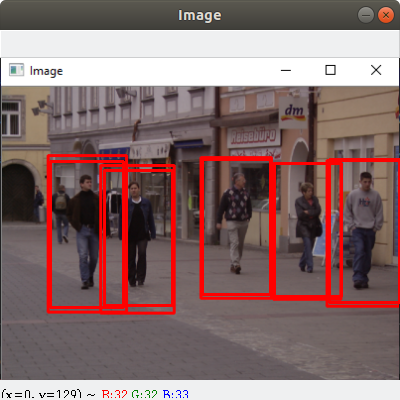
In this example, the HOG descriptor and OpenCV's pre-trained SVM detector are used to identify pedestrians in an image and draw bounding boxes around them.
Image Used:👁 python-opncv
Output:👁 python-opnecv-1
In this example, each frame of a video is processed using the HOG + SVM detector. Detected pedestrians are highlighted with bounding boxes in real time.
Output: