|
VOOZH | about |
|
VOOZH | about |
Polars is an exciting alternative to traditional data manipulation libraries like Pandas. It's built for high-performance data processing, particularly for handling large datasets. One of its powerful features is the ability to efficiently read and process various file formats, including JSON. In this article, we will discuss how to use Polars to read JSON files using the polars.read_json() function.
Polars provides the read_json() function to read JSON files and convert them into Polars DataFrames, which are similar to Pandas DataFrames but optimized for speed and memory efficiency.
Syntax:
file_path: This is the path to the JSON file that we want to read.
Let’s walk through an example where we read a JSON file into a Polars DataFrame.
Assume we have a data.json file with the following structure:
We can read this JSON file into a Polars DataFrame as follows:
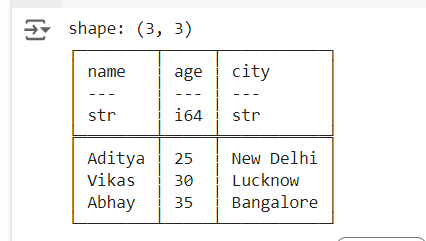
Output:
As we can see, Polars reads the JSON file and converts it into a DataFrame that is easy to manipulate.
Polars also supports reading nested JSON structures. Here’s an example of a more complex JSON file:
nested_data.json
To read this nested JSON file:
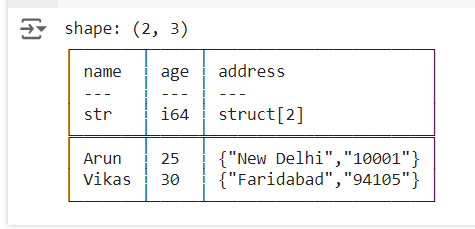
Output:
Polars preserves the structure of the nested JSON, representing the address field as a structdatatype, which can be further explored if necessary.
Polars is optimized for performance and can efficiently handle large JSON files. For instance, it can load files in a multi-threaded manner, making it suitable for big data workloads. The performance is significantly faster than traditional libraries like Pandas, especially when dealing with gigabytes of data.
Polars offers a fast and efficient way to read JSON files into DataFrames using the polars.read_json() function. Whether you're working with simple JSON structures or more complex nested objects, Polars can handle them with ease. Its performance makes it an excellent choice for large-scale data processing and handling large JSON datasets.
For those looking to optimize their data pipelines, Polars is a strong alternative to consider, especially for JSON-based data workloads.
With Polars, reading and processing JSON files is both fast and straightforward, making it a valuable tool for modern data processing tasks.