Both
__delete__ and
__del__ are
dunder or magic methods in Python. Dunder or magic methods in Python are the methods having two prefix and suffix underscores in the method name. Dunder here means “Double Under (Underscores)”. These are commonly used for operator overloading.
__del__
__del__ is a destructor method which is called as soon as all references of the object are deleted i.e when an object is garbage collected.
Syntax:
def __del__(self):
 body of destructor
 .
 .
Example: Here is the simple example of destructor. By using del keyword we deleted the all references of object ‘obj’, therefore destructor invoked automatically.
Output:
Example Instance.
Destructor called, Example deleted.
Note : The destructor was called after the program ended or when all the references to object are deleted i.e when the reference count becomes zero, not when object went out of scope.
__delete__
__delete__ is used to delete the attribute of an instance i.e removing the value of attribute present in the owner class for an instance.
Note: This method only deletes the attribute which is a descriptor.
Syntax:
def __delete__(self, instance):
 body of delete
 .
 .
Example:
Output:
Example Instance.
Deleted in Example object.
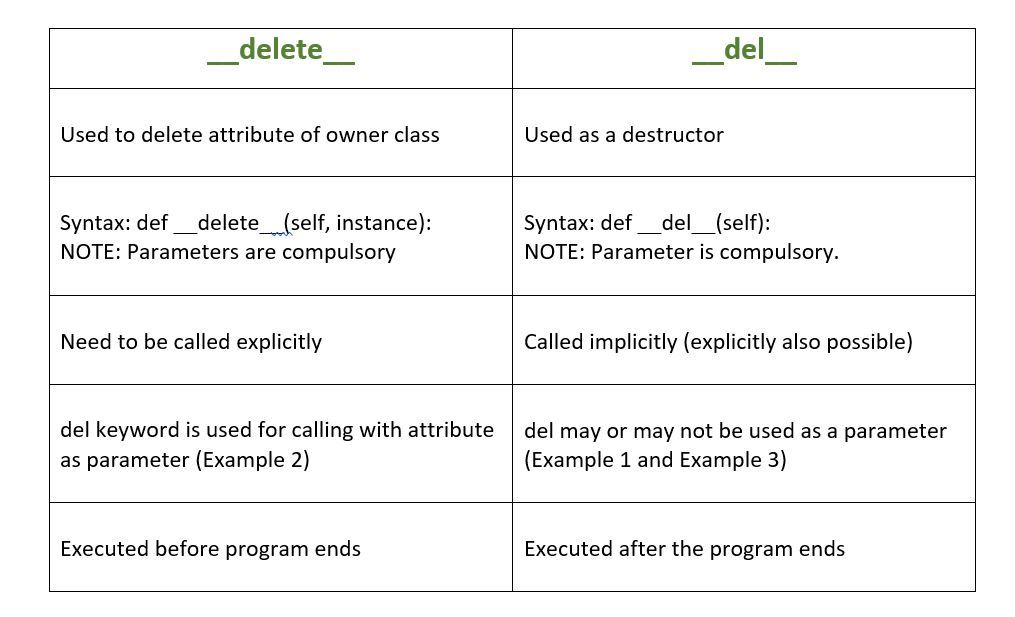
Difference between __delete and __del__
👁 Image
Example: A combine example of
__del__ and
__delete__.