|
VOOZH | about |
|
VOOZH | about |
In this discussion, we will delve into retrieving Python Falcon - get POST data. Falcon is a lightweight and speedy web framework explicitly crafted for constructing RESTful APIs. Effective handling of POST data is essential in API development, enabling the creation, updating, or manipulation of resources. This article process of skillfully retrieving POST data using Falcon.
The following are key concepts related to obtaining Python Falcon - get POST data.
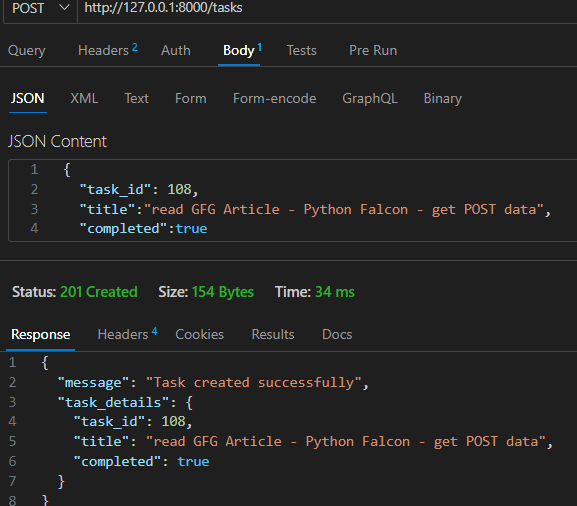
This Python code defines a RESTful API using the Falcon web framework. The API handles POST requests to create new tasks. The `TaskResource` class, when triggered by a POST request, retrieves and parses JSON data from the request body. It then extracts task details such as task ID, title, and completion status. If both task ID and title are present, it processes the task (in this case, printing the details) and responds with a success message and the task details in JSON format. If either the JSON data is invalid, or if task ID or title is missing, appropriate error responses are generated. The Falcon application sets up a route at '/tasks' for the `TaskResource` class, and the development server is initiated to run the API on 'http://127.0.0.1:8000/'. The server listens for incoming requests, and upon execution, it prints the server address and serves the API indefinitely.
Run the server
python app.py Serving on http://127.0.0.1:8000/tasks
Output:
Video demonstration
In conclusion, the provided Python Falcon code demonstrates the handling of POST requests to create tasks in a RESTful API. Leveraging the Falcon web framework, the code efficiently retrieves and parses JSON data from the request body, extracting essential task details. Error handling is implemented to address scenarios such as invalid JSON format or missing task information. The resulting API, accessible at '/tasks', showcases Falcon's simplicity and effectiveness in building lightweight and performant RESTful services. The code is well-structured, emphasizing the framework's capabilities in handling HTTP requests and responses seamlessly.