|
VOOZH | about |
|
VOOZH | about |
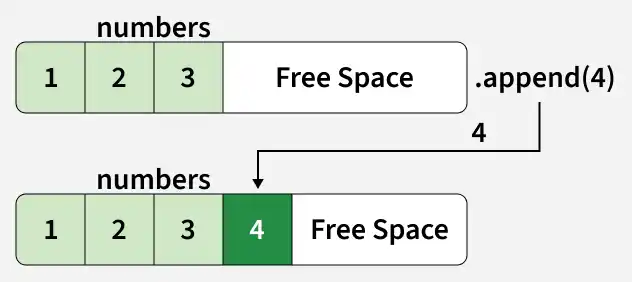
append() method is used to add a single element to the end of a list. It updates the original list directly and can add elements of any data type such as numbers, strings, lists or objects.
Example: In this example, append() adds a new value to the end of the list.
[2, 5, 6, 7, 8]
Explanation: append(8) adds 8 to the end of the list a.
list.append(element)
Example 1: In this example, we append elements of different data types to a list. Python lists can store multiple types of values together.
[1, 'Python', 3.14, True]
Explanation: append() adds 3.14 and True to the end of the list.
Example 2: Here, a list is appended to another list. The appended list becomes a single nested element inside the main list.
[1, 2, 3, [4, 5]]
Explanation: append([4, 5]) adds the entire list as one element, creating a nested list.
Example 3: Here, append() is used inside a loop to add multiple values one by one into a list.
[0, 1, 2, 3, 4]
Explanation: append(i) adds each value of i to the list during every loop iteration.