LRU Cache is the least recently used cache which is basically used for Memory Organization. In this, the elements come as
First in First Out format. We are given total possible page numbers that can be referred to. We are also given cache (or memory) size (Number of page frames that cache can hold at a time). The LRU caching scheme is to remove the least recently used frame when the cache is full and a new page is referenced which is not there in the cache. There are generally two terms use with LRU Cache, let's see them -
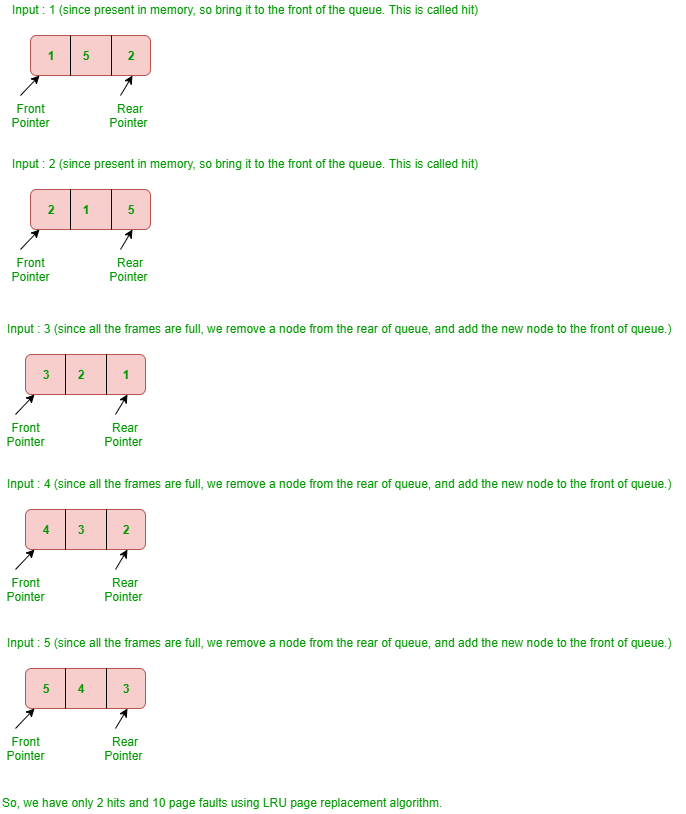
- Page hit: If the required page is found in the main memory then it is a page hit.
- Page Fault: If the required page is not found in the main memory then page fault occurs.
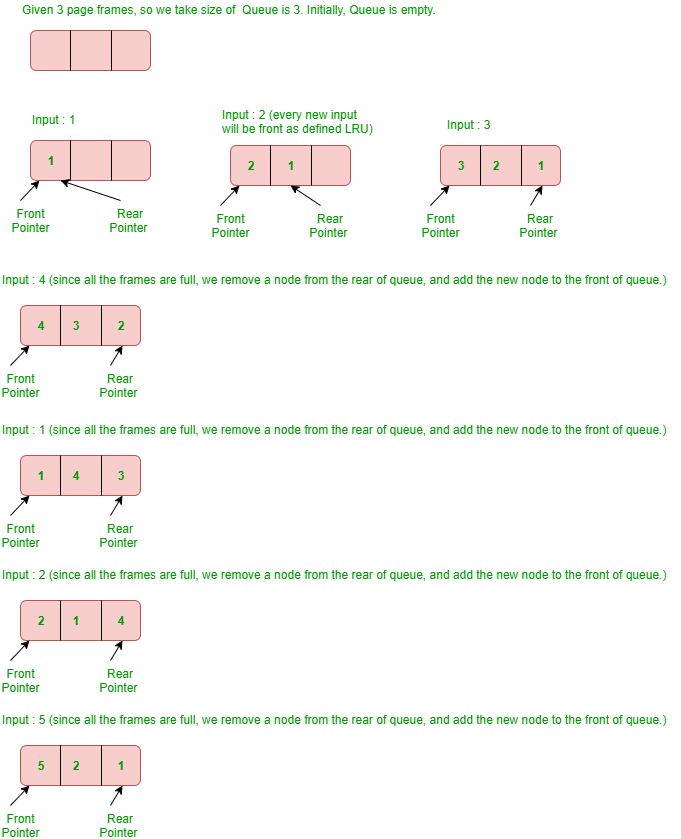
When a page is referenced, the required page may be in the memory. If it is in the memory, we need to detach the node of the list and bring it to the front of the queue.
If the required page is not in memory, we bring that in memory. In simple words, we add a new node to the front of the queue and update the corresponding node address in the hash. If the queue is full, i.e. all the frames are full, we remove a node from the rear of the queue, and add the new node to the front of the queue.
Example – Consider the following reference string :
1, 2, 3, 4, 1, 2, 5, 1, 2, 3, 4, 5
Find the number of page faults using least recently used (LRU) page replacement algorithm with 3 page frames.
Explanation –
👁 LRU1
👁 LRU2
LRU Cache Using Python
You can implement this with the help of the queue. In this, we have used Queue using the linked list. Run the given code in Pycharm IDE.
Output:
Function: ex_func_01
Computing...1
1
Cache: {(1,): 1}
Computing...2
2
Cache: {(1,): 1, (2,): 2}
Computing...3
3
Cache: {(1,): 1, (2,): 2, (3,): 3}
Computing...4
4
Cache: {(1,): 1, (2,): 2, (3,): 3, (4,): 4}
Cached...(1,)
1
Cache: {(2,): 2, (3,): 3, (4,): 4, (1,): 1}
Cached...(2,)
2
Cache: {(3,): 3, (4,): 4, (1,): 1, (2,): 2}
Computing...5
5
Cache: {(4,): 4, (1,): 1, (2,): 2, (5,): 5}
Cached...(1,)
1
Cache: {(4,): 4, (2,): 2, (5,): 5, (1,): 1}
Cached...(2,)
2
Cache: {(4,): 4, (5,): 5, (1,): 1, (2,): 2}
Computing...3
3
Cache: {(5,): 5, (1,): 1, (2,): 2, (3,): 3}
Computing...4
4
Cache: {(1,): 1, (2,): 2, (3,): 3, (4,): 4}
Computing...5
5
Cache: {(2,): 2, (3,): 3, (4,): 4, (5,): 5}