|
VOOZH | about |
|
VOOZH | about |
MongoDB is a cross-platform document-oriented and a non relational (i.e NoSQL) database program. It is an open-source document database, that stores the data in the form of key-value pairs. MongoDB is developed by MongoDB Inc. and was initially released on 11 February 2009. It is written in C++, Go, JavaScript, and Python languages. MongoDB offers high speed, high availability, and high scalability.
This is a method by which we can insert a single entry within the collection or the database in MongoDB. If the collection does not exist this method creates a new collection and insert the data into it. It takes a dictionary as a parameter containing the name and value of each field in the document you want to insert in the collection.
This method returns an instance of class "~pymongo.results.InsertOneResult" which has a "_id" field that holds the id of the inserted document. If the document does not specify an "_id" field, then MongoDB will add the "_id" field and assign a unique object id for the document before inserting.
Syntax:
collection.insert_one(document, bypass_document_validation=False, session=None, comment=None)
Parameters:
Example 1:
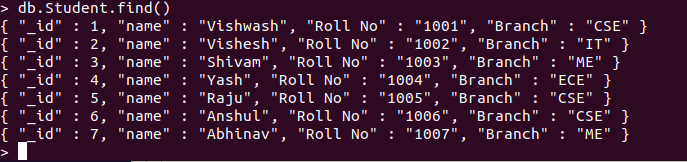
Sample database is as follows:
Example
Output:
Example 2: Inserting multiple values
To insert multiple values, 2 Methods can be followed:
#1: Naive Method: Using for loop and insert_one