|
VOOZH | about |
|
VOOZH | about |
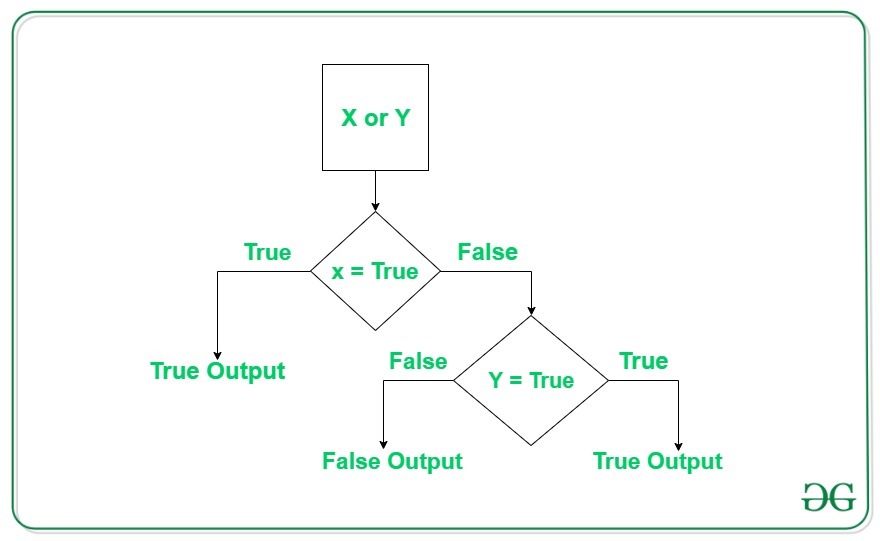
Python OR Operator takes at least two boolean expressions and returns True if any one of the expressions is True. If all the expressions are False then it returns False.
| Expression 1 | Expression 2 | Result |
|---|---|---|
| True | True | True |
| True | False | True |
| False | True | True |
| False | False | False |
Python OR operator returns True in any one of the boolean expressions passed is True.
bool1: False
bool2: True
OR operator: True
We can use the OR operator in the if statement. We can use it in the case where we want to execute the if block if any one of the conditions becomes if True.
a either a multiple of 3 or 5
a is not a multple of 3 or 5
a either a multiple of 3 or 5
The Python Or operator always evaluates the expression until it finds a True and as soon it Found a True then the rest of the expression is not checked. Consider the below example for better understanding.
Inside True
Case 1
True

Inside True
Case 2
True

Inside False
Inside False
Case 3
False

Inside False
Inside True
Case 4
True
From the above example, we can see that the short circuit or lazy evaluation is followed. In case1 and case2, the second expression is not evaluated because the first expression returns True, whereas, in case3 and case4 the second expression is evaluated as the first expression does not returns True.