|
VOOZH | about |
|
VOOZH | about |
Given a Directed Acyclic Graph (DAG), the task is to find a linear order of its vertices such that for every directed edge u -> v, vertex u appears before v in the order. Topological Sorting is a technique used to arrange vertices of a DAG in a sequence that respects all dependencies. It ensures that no vertex appears before any of its prerequisites.
For Example:
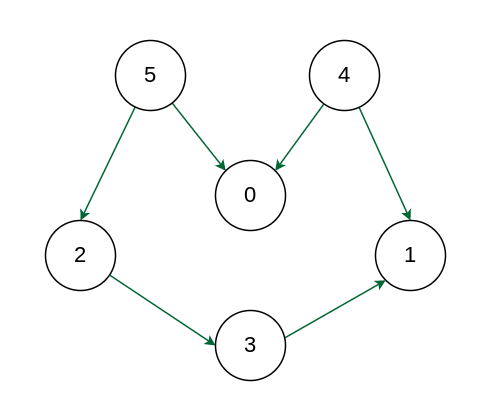
Input Graph:
👁 topologicalSortingOutput: 5 4 2 3 1 0
Explanation: Vertex 5 and 4 have no incoming edges, so they appear first. Each vertex appears only after all vertices pointing to it have been placed earlier in the order.
It works by repeatedly removing nodes with zero in-degree (no incoming edges) and adding them to the topological order until all nodes are processed. Here in this code, we use a queue to store vertices with zero in-degree and gradually build the order.
[4, 5, 2, 0, 3, 1]
Explanation:
This approach uses Depth-First Search (DFS) and recursion to find the topological order of a Directed Acyclic Graph (DAG). It explores all dependencies first and then adds the node to a stack, ensuring the correct order. The final sequence is obtained by reversing the stack.
[5, 4, 2, 3, 1, 0]
Explanation:
This method eliminates recursion and uses an explicit stack to simulate DFS traversal. It employs generators for efficient neighbor iteration and manually manages backtracking. This approach is useful for handling large graphs without hitting recursion limits.
Topological Sort using Iterative DFS:
[5, 4, 2, 3, 1, 0]
Explanation:
Please refer complete article on Topological Sorting for more details.