|
VOOZH | about |
|
VOOZH | about |
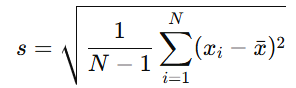
The stdev() function in Python's statistics module is used to calculate the standard deviation of a dataset. It helps to measure the spread or variation of values in a sample. Standard deviation (SD) measures the spread of data points around the mean. A low SD indicates data points are close to the mean, while a high SD shows they are spread out. Unlike variance, SD is in the same units as the data, making it easier to interpret.
Where:
Example:
1.5811388300841898
statistics.stdev(data, xbar=None)
Parameters:
Returns: The standard deviation of the values in the dataset.
Example 1: In this example, we calculate the standard deviation for four datasets to measure the spread, including integers, floating-point numbers and negative values.
3.9761191895520196
1.8708286933869707
7.8182478855559445
0.41967844833872525
Example 2: In this example, we calculate the standard deviation and variance for a dataset to measure the spread of values.
1.5811388300841898
2.5
Example 3: In this example, we calculate the standard deviation by providing a precomputed mean using the xbar parameter in the stdev() function to avoid recalculating the mean.
0.6047037842337906
Example 4: In this example, we attempt to calculate the standard deviation of a dataset with a single data point. Since stdev() requires at least two points, it raises a StatisticsError, which is handled using a try-except block.
Output
Error: stdev requires at least two data points