|
VOOZH | about |
|
VOOZH | about |
In this article, we will learn about Cluster Hierarchy Dendrogram using Scipy module in python. For this first we will discuss some related concepts which are as follows:
Hierarchical clustering requires creating clusters that have a predetermined ordering from top to bottom. It is a type of unsupervised machine learning algorithm used to cluster unlabeled data points.
1. Divisive clustering
Divisive clustering, also known as the top-down clustering method assigns all of the observations to a single cluster and then partition the cluster into two least similar clusters.
2. Agglomerative clustering
In the agglomerative or bottom-up clustering method, each observation is assigned to its own cluster.
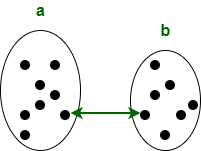
1. Single Linkage
Single linkage clustering often yields clusters in which individuals are added sequentially to a single group. The distance between the two clusters is defined as the distance between their two nearest data points.
L(a , b) = min(D(xai , xbj))👁 Image
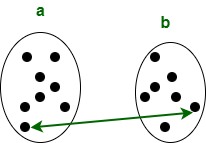
2. Complete Linkage
Complete linkage clustering generally yields clusters that are well segregated and compact. The distance between the two clusters is defined as the longest distance between two data points in each cluster.
L(a , b) = max(D(xai , xbj))👁 Image
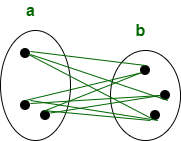
3. Simple Average
The simple average algorithm defines the distance between clusters as the average distance between each of the members, weighted so that the two clusters have an equal influence on the final output.
L(a , b) = Tab / ( Na * Nb)
Tab: The sum of all pairwise distances between the two clusters.
Na and Nb: The sizes of the clusters a and b, respectively.
👁 Image
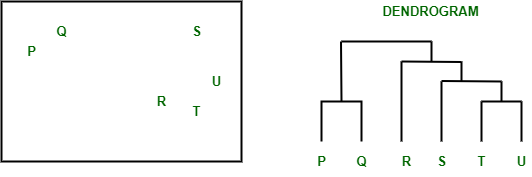
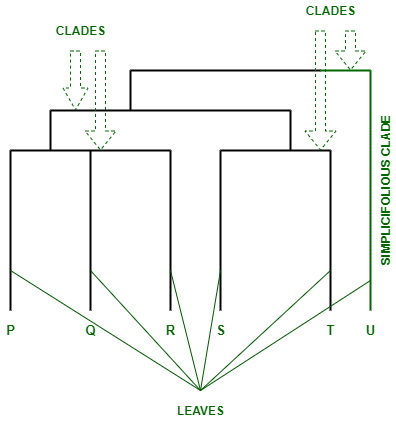
A Dendrogram is a tree-like diagram used to visualize the relationship among clusters. More the distance of the vertical lines in the dendrogram, the more the distance between those clusters. The key to interpreting a dendrogram is to concentrate on the height at which any two objects are joined together.
Example of a dendrogram:
Suppose we have six clusters: P, Q, R, S, T, and U. Cluster Hierarchy Dendrogram of these six observations shown on the scatterplot is:
Parts of a dendrogram:
For implementing the hierarchical clustering and plotting dendrogram we will use some methods which are as follows:
Syntax: scipy.cluster.hierarchy.linkage(ndarray , method , metric , optimal_ordering)
Syntax: scipy.cluster.hierarchy.dendrogram(Z , p , truncate_mode , color_threshold , get_leaves , orientation , labels , count_sort , distance_sort , show_leaf_counts , no_plot , no_labels , leaf_font_size , leaf_rotation , leaf_label_func , show_contracted , link_color_func , ax , above_threshold_color)
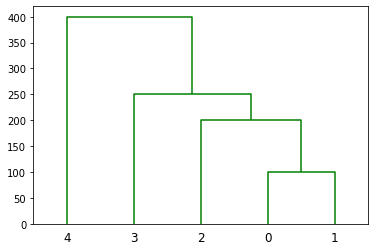
Example 1: Normal Dendrogram
Output:
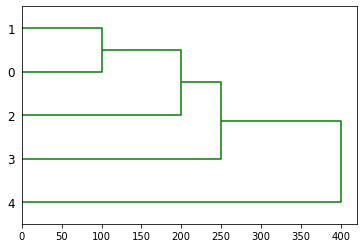
👁 ImageExample 2: Dendrogram using horizontal orientation:
Output:
👁 ImageThe parameter orientation of scipy.cluster.hierarchy.dendrogram has been set to 'right'. It plots the root at the right, and plot descendant links going left.