VOOZH about

URL: https://www.geeksforgeeks.org/python/sys-path-in-python/

⇱ sys.path in Python - GeeksforGeeks


  • Courses
  • Tutorials
  • Interview Prep

sys.path in Python

Last Updated : 21 Aug, 2024

Sys is a built-in Python module that contains parameters specific to the system i.e. it contains variables and methods that interact with the interpreter and are also governed by it. 

sys.path

sys.path is a built-in variable within the sys module. It contains a list of directories that the interpreter will search in for the required module. 

When a module(a module is a python file) is imported within a Python file, the interpreter first searches for the specified module among its built-in modules. If not found it looks through the list of directories(a directory is a folder that contains related modules) defined by sys.path.

Initializing sys.path

There are three ways to specify a path :

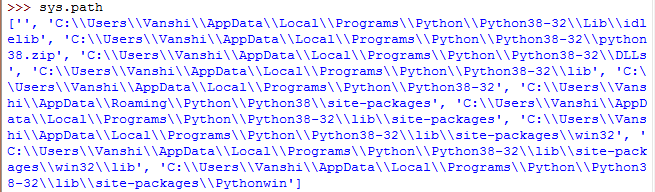
  • DEFAULT- By default, the interpreter looks for a module within the current directory. To make the interpreter search in some other directory you just simply have to change the current directory. The following example depicts a default path taken by the interpreter:

Output:

👁 Image
  • THROUGH ENVIRONMENT VARIABLES- An environment variable that contains the path an interpreter can take while looking for modules can be employed. Once set, it hints interpreter with directories to locate a module.  The following example shows how this can be done.
PYTHONPATH=C:\Users\Vanshi\Desktop

Output:

👁 Image
  • APPENDING PATH- append() is a built-in function of sys module that can be used with path variable to add a specific path for interpreter to search. The following example shows how this can be done.

Output:

👁 Image

Note that the first string returned by path is always empty this is to indicate the interpreter to check in the current directory.

Comment
Article Tags:
Article Tags: