|
VOOZH | about |
|
VOOZH | about |
The Template method is a that defines the skeleton of the operation and leaves the details to be implemented by the child class. Its subclasses can override the method implementations as per need but the invocation is to be in the same way as defined by an abstract class. It is one of the easiest among the Behavioral design pattern to understand and implements. Such methods are highly used in framework development as they allow us to reuse the single piece of code at different places by making certain changes. This leads to avoiding code duplication also.
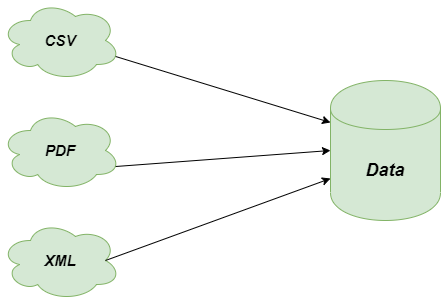
Imagine you are working on a Chatbot application as a software developer which uses data mining techniques to analyze the data of the corporate documents. Initially, your applications were fine with the pdf version of the data only but later your applications also require to collect and convert data from other formats also such as XML, CSV, and others. After implementing the whole scenario for the other formats also, you noticed that all the classes have lots of similar code. Part of the code like analyzing and processing was identical in almost all classes whereas they differ in dealing with the data.
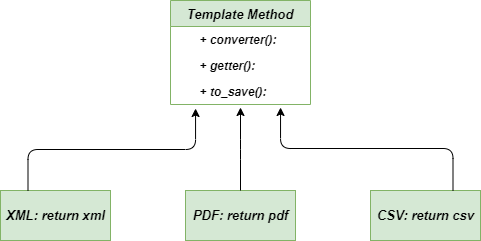
Let's discuss the solution to the above-described problem using the template method. It suggests to break down the code into a series of steps and convert these steps into methods and put series call inside the template_function. Hence we created the template_function separately and create methods such as get_xml, get_pdf and get_csv for dealing with the code separately.
Got `plain_text`
Skip conversion
[SAVE]
`plain_text` was processed
Got `pdf`
[CONVERT]
`pdf as text` was processed
Got `csv`
Skip conversion
[SAVE]
`csv` was processed
Following is the class diagram for the Template Method
Further Read - Template Method in Java