|
VOOZH | about |
|
VOOZH | about |
Let us start our journey to Conda, a versatile and indispensable tool for data scientists, analysts, and developers. This sophisticated tool goes beyond the limitations of traditional management systems, delivering a holistic solution that simplifies the process of configuring, managing, and deploying software packages and dependencies life is hassle-free in the world of technology.
In this article, we will cover topics like installation, environment management, package handling, advanced usage, how to troubleshoot, its comparison to other tools out there, and integration with third-party applications.
Table of Content
Conda is an open-source package management and environment management system that is widely used in the scientific computing and data science communities. It helps users manage software packages, dependencies, and environments, making it easier to install, run, and maintain different software tools and libraries.
Here are some key features and aspects of Conda:
Installation of Conda is quite simple. Just follow these steps and you will be able to install and run Conda on your system.
First, you must choose between the Anaconda and Miniconda Conda distributions before starting the installation.
In this article, we will be installing Miniconda.
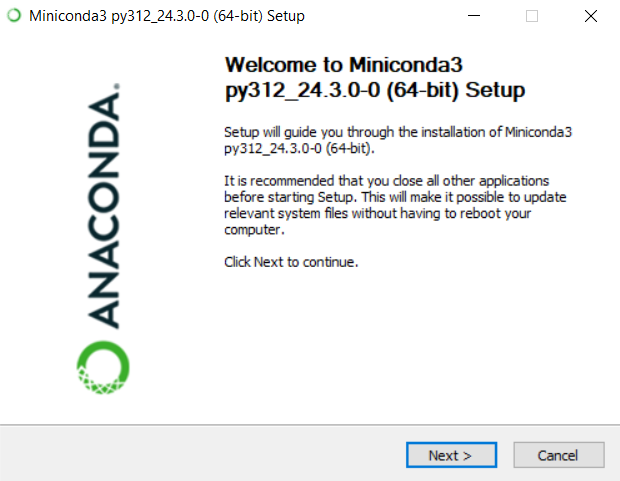
Visit the official Conda distribution website after selecting the one that best meets your needs and download the appropriate installer for your operating system (Windows, macOS, or Linux).
Find the installer file in your file explorer after downloading it, and double-click to launch the installation wizard. To continue with the installation, follow the on-screen instructions.
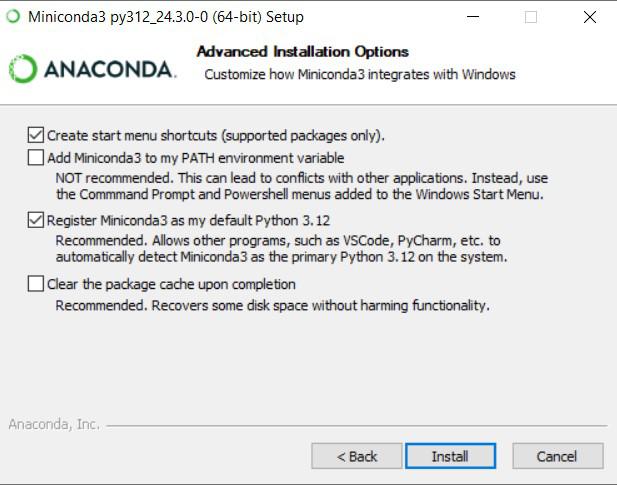
You will be given various options to personalize your Conda installation during the installation process. These are some important decisions you might have to make:
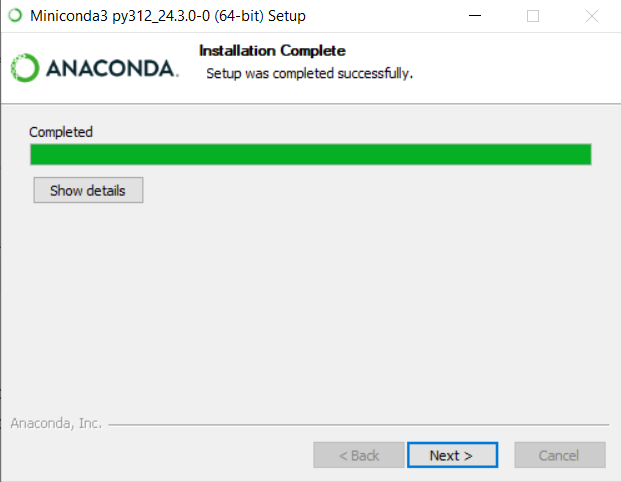
Continue with the installation procedure after you've customized the installation options to your preference. The installer will set up Conda correctly and copy the required files to your system.
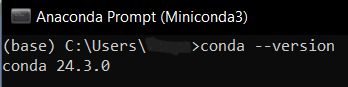
Once the installation is finished, you can run the following command in a new terminal or command prompt window to confirm that Conda has been installed correctly:
conda --versionThe version number of Conda should show up in the terminal or command prompt if the installation went well.
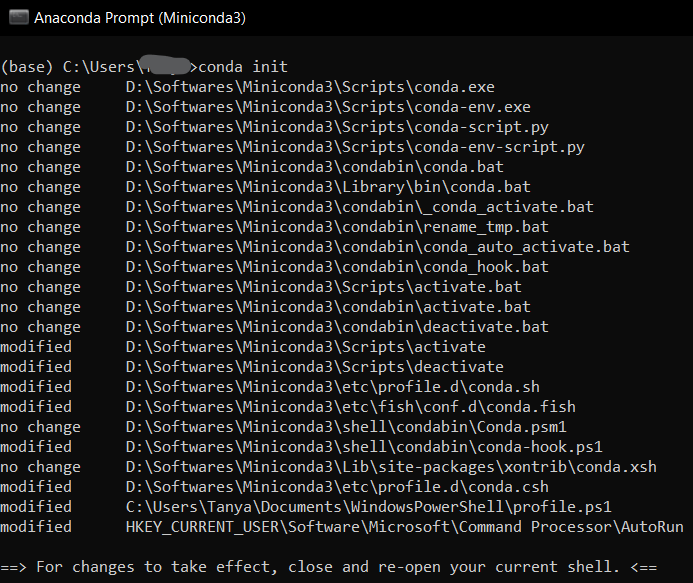
Conda must be initialized by executing the following command before you can use it. By using this command, you can set your shell to automatically activate the base Conda environment and recognize Conda commands.
conda init
You can use Conda to manage your environments and install packages now that it has been installed and initialized. Simple Conda commands like conda create, conda activate, and conda install allow you to create a new environment, activate it, and start installing packages.
Conda shines in data science and software development because it offers a strong environmental strategy. It allows users to configure sites, each with its own dependencies and packages, so you can work on multiple projects at once without worrying about incompatibilities or conflict of interest.
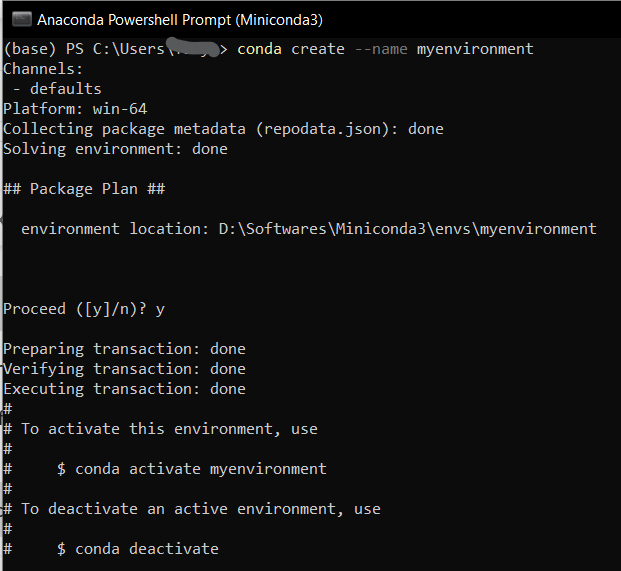
In Conda, creating a new environment is a simple process. Just type the following command in the miniconda prompt.
conda create -- name myenvironmentThis command creates an environment with the name myenvironment.
Users can also add commands to install specific packages in the environment by adding the names in the above command.
conda create -- name myenvironment python=3.8 numpyThis creates the environment myenvironment with Python 3.8 interpreter and numpy loaded in as well.
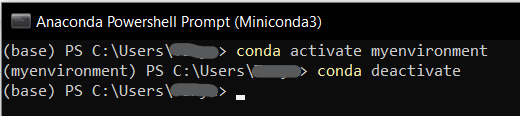
The conda activate command and the environment name is used to activate a newly created environment. The myenvironment environment will be launched upon execution of this command, and it will be used for any further Python executions or package installations.
conda activate myenvironmentThe conda deactivate command can be used to end an active environment and resume the base environment. By using this command, you will go back to the base environment and deactivate the current environment.
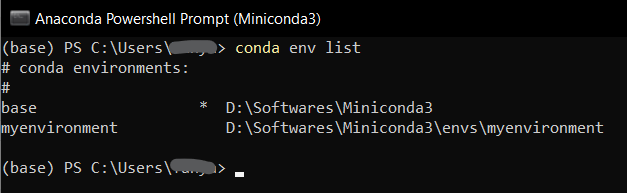
conda deactivateThe conda env list command can be used to see a list of all environments that are available on your system. The names of all current environments and their corresponding disk locations will be shown by this command.
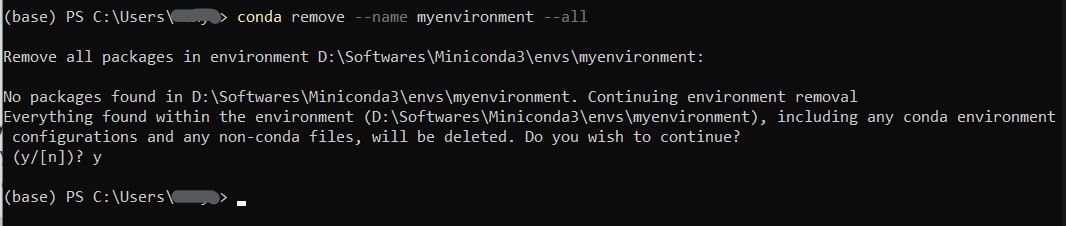
conda env listThe conda env remove command, followed by the environment name, can be used to remove an environment if it is no longer needed. By running this command, you can clean up disk space and get rid of all packages and dependencies along with the myenvironment environment.
conda remove --name myenvironment --allConda allows you to export an environment's specifications to a YAML file that you can share or use to duplicate the environment on another computer. Use the conda env export command and the environment name to export the environment specs to a YAML file. he myenvironment environment's specifications will be exported with this command and saved in a file called myenvironment.yml.
conda env export > myenvironment.yml This command will create yml file in the directory from where this command is executed. You can further share this file via email or Git.
As you can see, users can easily create, manage, and share isolated environments thanks to Conda's environment management features allowing you to simplify dependency management, optimize workflow, and concentrate on what really matters—creating amazing software.
In the intricate world of data science and software development, managing dependencies is essential. Conda's powerful package handling capabilities make this process simpler. Let us look at the basic features Conda provides in handling packages:
Conda makes package installation simple. The package name you wish to install should be followed by the conda install command. The numpy package will be installed in the active environment by using this command.
conda install numpyBy adding the version number after the package name, you can additionally indicate which version of the package you wish to install.
conda install numpy=1.21.0 The numpy package version 1.21.0 will be installed using this command.
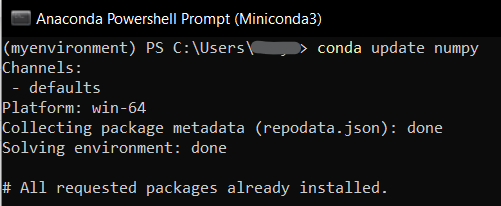
Updating your packages is crucial to preserving compatibility and security. The conda update command in Conda makes it simple to update packages to the most recent versions.
conda update numpyWith this command, the numpy package will be updated to the most recent version that is available in the Conda repository.
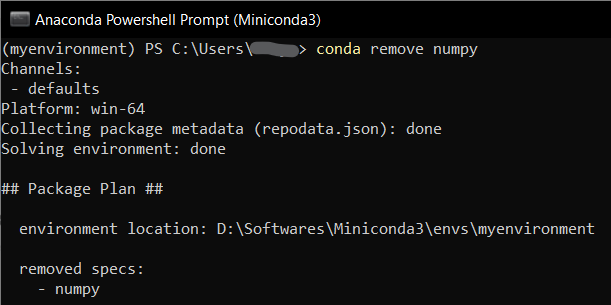
Use the conda remove command and the package name to remove a particular package from your environment if you no longer need it.
conda remove numpyBy removing the numpy package from your environment, you'll clear up disk space and get rid of any dependencies that came with it.
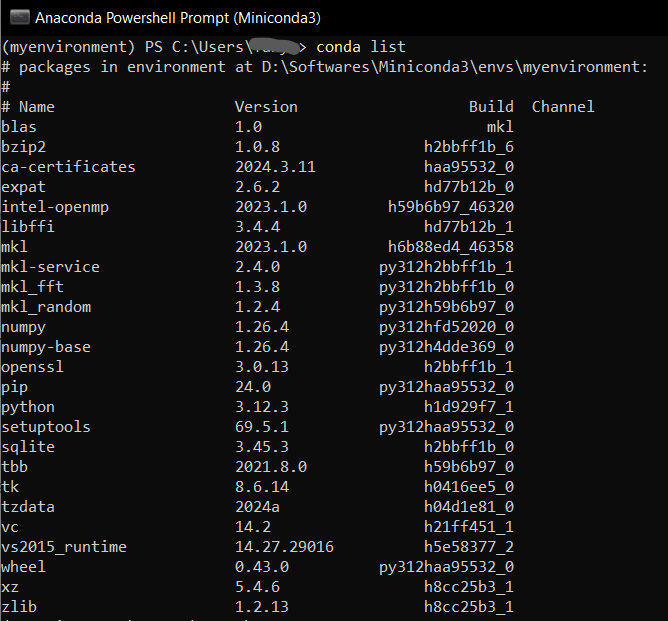
Use the conda list command to see a list of every package installed in your environment. All installed packages' names, versions, and corresponding channels will be shown by this command.
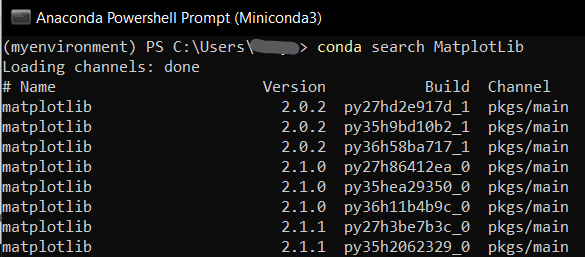
conda listUse the conda search command to look for packages by keyword if you are unsure of a package's exact name. The packages that are connected to the keyword "matplotlib," along with their versions and channels, will be shown by this command.
conda search MatplotLibYou can make personalized packages with Conda and distribute them to other users. Packages can be built from source code or recipes using tools such as conda build, then uploaded to your own package repository. This makes it possible for you to share your dependencies and software with others and promotes teamwork.
To sum up, Conda's package handling features make software development processes more efficient and make dependency management simpler. Now, let us look at some advanced uses of Conda.
Conda offers many sophisticated features for power users in addition to a user-friendly interface for managing environments and packages. Users can tailor their environments and workflows to meet their unique requirements with Conda's advanced usage capabilities, which include version control, dependency pinning, environment freezing, and reproducibility.
With version numbers or version specifiers, Conda enables you to define precise versions of dependencies and packages. You can pin a package to a particular version.
conda install numpy=1.21.0 This command installs the numpy package version 1.21.0. Version specifiers can also be used to define an acceptable version range.
conda install "numpy>=1.20,<1.22" Here, any version of Numpy between 1.20 (inclusive) and 1.22 (exclusive) can be installed with this command.
In order to preserve the current state of an environment for later use, freezing entails saving all installed packages and their dependencies in a file. This guarantees that the environment can be precisely recreated as it was at a given time. The conda list --export command can be used to freeze an environment in the manner described here:
conda list --export > environment.ymlThe installed packages and their versions are exported by this command to a YAML file called environment.yml. Then, using the conda env create command, you can use this file to replicate the environment on a different machine.
Conda makes it simple to replicate environments from YAML files and share them with others, which promotes reproducibility and environment sharing. The conda env create command can be used to create a new environment from a YAML file in the following manner:
conda env create --file environment.ymlBy using the parameters in the environment.yml file, this command builds a new environment. At that point, you can turn on the environment and begin working in it.
Conda also offers an easy way to share and work together on environments: it lets you manage environments straight from YAML files. With the conda env export command, you can export the current state of an environment to a YAML file, make any necessary modifications to the file, and then use the conda env update command to recreate the environment from the modified file.
Users can distribute their own packages and dependencies using Conda's support for custom channels and package repositories. With the conda index command, you can make your own channel, and the anaconda upload command allows you to upload packages to it. After you've configured your channel, users can add it to their Conda configuration and install packages.
Therefore, Conda helps you to ensure reproducibility and consistency across your projects by streamlining your development process, whether you're freezing environments, managing custom channels, or pinning dependencies. Now, what if we face issues despite these features? Let us look at how to troubleshoot some common problems you might face in your experience with Conda.
Although Conda aims to offer a flawless package and environment management experience, users might occasionally run into problems and errors. In this section, we'll examine typical issues users might run into with Conda and offer fixes.
Outdated Conda installations are one common problem that users might run into. You can use the following command to update Conda and make sure you have the most recent version of both it and its dependencies. The Conda package manager will be updated to the most recent version via this command.
conda update condaInstalling or updating packages can lead to dependency conflicts, particularly in complex environments where there are many dependencies. You can try updating or installing a specific version of the package, or you can try removing conflicting packages from your environment, to resolve dependency conflicts.
Disk space problems could arise from Conda's cache directory accumulating extra files over time. Disk space will be freed up by running this command to remove unnecessary packages and cached files from the Conda cache directory. The following command can be used to clear the Conda cache:
conda clean --allYou can attempt to fix errors related to particular packages by reinstalling them. You can use the following command to reinstall a package. The specified package will be reinstalled using this command, overwriting any previous dependencies and files.
conda install --force-reinstall <package-name>Problems with package channels or repositories can sometimes result in package installation errors. Make sure the packages you're trying to install are available in the Conda channels that you have set up correctly.
Make sure your Conda environment is up to date with the most recent specifications if you're working in a shared workspace or collaborating with others. With the following command, you can update your environment from a YAML file. Your environment will be updated with this command to conform to the details in the environment.yml file.
conda env update --file environment.ymlFor troubleshooting advice, solutions, and support from knowledgeable users and developers, the Conda documentation, forums, and community channels are excellent resources available in the Conda Community.
You can overcome difficulties and guarantee a flawless Conda experience by using the troubleshooting methods described in this guide and the community's support when required. Recall that troubleshooting frequently entails trial and error until the problem is fixed, so be patient and persistent.
Conda’s unique features and functionality set it apart from other package managers. However, it is important to understand how Conda compares to other package managers and integrates with pre-existing tools and ecosystems.
This section will explain how it integrates with other tools and environments.
Conda has integrations with a number of well-known integrated development environments (IDEs), including VS Code, PyCharm, and Jupyter Notebook. Installing packages straight from the IDE and switching between environments is made simple by the built-in support for managing Conda environments that these IDEs offer.
Git and other version control systems can be used to version and share Conda environments. You can guarantee consistency and reproducibility between various development environments by including environment specification files (like environment.yml) in your project repository.
Conda is compatible with cloud platforms, including Microsoft Azure, Google Cloud Platform, and Amazon Web Services. These platforms provide cloud application deployment and management environments and tools that are compatible with Conda.
Conda, in summary, differs from other package managers with its special features and capabilities. For Python developers, data scientists, and researchers, its strong environment management, package dependency resolution, and platform compatibility make it a desirable option. Users can fully utilize Conda to optimize their development workflows and increase productivity by learning how it stacks up against other package managers and how it works with their current tools and environments.
For software development and data science, Conda offers all-inclusive and environmental solutions. It gives users the freedom to create, manage and share environments thanks to a simple installation process, sophisticated usage features and troubleshooting. Its robust package control capabilities, reproducibility and environment isolation make it a valuable tool for researchers, data scientists and developers to continuously improve. This way, users can use their focus is on building better software by leveraging Konda’s features and capabilities to increase performance, guarantee repeatability and compatibility.