|
VOOZH | about |
|
VOOZH | about |
Prototyping is a critical stage in product design that allows teams to visualize ideas before finalizing them as products. It helps identify design flaws early, gather user feedback, and reduce risks, ensuring the final product aligns with user needs and project goals.
Two main types are:
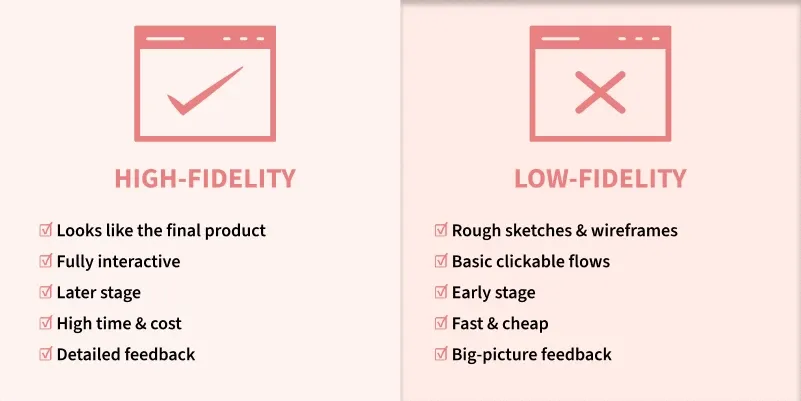
High-fidelity prototypes are highly detailed and closely resemble the final product in terms of design, functionality, and user interaction. They are typically interactive and used in the later stages of development to simulate the end-user experience as realistically as possible.
Low-fidelity prototypes are simplified and basic, used in early design stages to convey ideas, test functionality, and gather initial feedback. They emphasize structure and user flows rather than detailed visuals or interactions.
| Aspect | High Fidelity | Low Fidelity |
|---|---|---|
| Development Stage | Later stages, closer to the final product launch | Early stages, exploring initial concepts |
| Stakeholder Presentation | Used to impress stakeholders, secure buy-in for the final product | Used for initial brainstorming, gathering early feedback and ideas |
| User Testing | Focuses on final usability testing with detailed feedback | Used for preliminary testing, gathering broad feedback on structure |
| Detail Required | High level of detail in visuals, interactions, and functionality | Basic structure and functionality with minimal detail |
| Time & Cost | Requires more time and higher cost investment | Quick to create and low-cost |
| Flexibility | Less flexible, harder to change or iterate | Highly flexible, easy to adjust and modify |
| Purpose | Validates the final product and refines intricate details | Explores concepts, gathers early input, and defines general structure |
| Visual Design | Detailed, polished, and realistic design | Rough sketches, wireframes, or simple shapes with minimal design elements |
| Application in Audio | High-quality, accurate sound reproduction | Lower quality, often with noise or distortion, used for initial ideas |
| Example in UI/UX Design | Final UI mockups with real content and refined details | Wireframes with placeholder text and images |
| Feedback Focus | Detailed feedback on specific features, visual design, and interactions | General feedback on overall layout, flow, and structure |