

|
A view of the former Republican Palace, Baghdad, Iraq
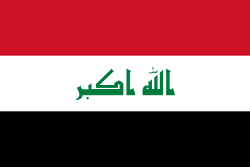
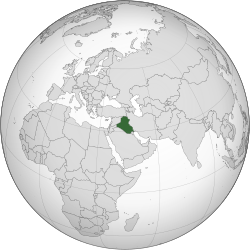
Iraq, officially the Republic of Iraq, is a country in West Asia. Located within the geo-political region of the Middle East, it is bordered by Saudi Arabia to the south, Turkey to the north, Iran to the east, the Persian Gulf and Kuwait to the southeast, Jordan to the southwest, and Syria to the west. The country covers an area of 438,317 square kilometres (169,235 sq mi) and has a population of over 46 million, making it the 58th largest country by area and the 31st most populous in the world. Baghdad, home to over 8 million people, is the capital city and the largest in the country. Since independence in 1932 after the defeat of the Ottoman Empire in World War I, Iraq has experienced spells of significant economic and military growth alongside periods of instability and conflict. Iraq emerged as a hashemite monarchy after centuries of Ottoman rule and a period under British administration. In 1958, a military coup led by Abdul Karim Qasim overthrew the monarchy and established a republic. Later, the Ba'ath Party took power in 1968, establishing a one-party state under Ahmed Hassan al-Bakr and later Saddam Hussein, who presided over war against Iran from 1980 to 1988 and then invaded Kuwait in 1990. In 2003, U.S.-led coalition forces invaded and occupied Iraq, overthrowing the government and triggering an insurgency and sectarian violence during the Iraq War, which ended in 2011. From 2013 to 2017, Iraq faced another major conflict with the rise and defeat of the Islamic State. Today post-war conflict continues at a lower scale, hampering stability alongside the rising influence of Iran. (Full article...) Selected article - show anotherIraqi literature or Mesopotamian literature dates back to Sumerian times, which constitutes the earliest known corpus of recorded literature, including the religious writings and other traditional stories maintained by the Sumerian civilization and largely preserved by the later Akkadian and Babylonian empire. Mesopotamian civilization flourished as a result of the mixture of these cultures and has been called Mesopotamian or Babylonian literature in allusion to the geographical territory that such cultures occupied in the Middle East between the banks of the Tigris and Euphrates rivers. As of 2024, the Iraqi Writers Union reported having 3,496 registered members, up from 2,006 in 1998, including 123 older members whose membership cards were renewed during the same period. Its activities included at least 300 books and magazines published annually, 1,000 literary sessions held per year across Baghdad and the provinces and at least 10 major literary festivals organized annually. (Full article...) Selected pictureDid you know...
Selected biography - show anotherBarham Salih (Kurdish: بەرھەم ساڵح, romanized: Berhem Salih; Arabic: برهم صالح, romanized: Barham Ṣāliḥ; born 8 September 1960) is an Iraqi-Kurdish politician who has been serving as United Nations High Commissioner for Refugees since 1 January 2026. He previously served as the president of Iraq from 2018 to 2022. Mr Salih also served as 2nd deputy secretary general of the Patriotic Union of Kurdistan. He is the former prime minister of the Kurdistan Region and a former deputy prime minister of the Iraqi federal government. He was elected and assumed office as president of Iraq on 2 October 2018. Salih is the third non-Arab president of Iraq, succeeding Fuad Masum, who is also Kurdish. In October 2022 he lost his re-election to Abdul Latif Rashid. (Full article...)
General imagesThe following are images from various Iraq-related articles on Wikipedia.
ListsTopicsCategoriesSelect [►] to view subcategories
Related portalsReligions in Iraq Arab states Other countries WikiProjectsThings you can do
Associated WikimediaThe following Wikimedia Foundation sister projects provide more on this subject:
Discover Wikipedia using portals | ||||||||
 |
VOOZH | about |




.svg)


.jpg)




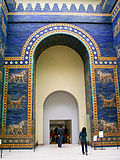


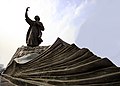


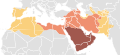


.jpg)


.svg)


.svg)


_(14766210391).jpg)





.jpg)





.jpg)







.svg)


