|
VOOZH | about |
|
VOOZH | about |
Carbon forms a large number of compounds known as carbon compounds. These compounds show various chemical reactions because carbon has the ability to form stable bonds with many elements, such as hydrogen, oxygen, nitrogen, and halogens. The chemical properties of carbon compounds mainly depend on the type of bonds present, the functional groups attached, and the arrangement of atoms in the molecule.
Examples:
Methane (CH4), Ethanol (C2H5OH), Ethanoic acid (CH3COOH), and Carbon dioxide (CO2).
Carbon compounds undergo various chemical reactions due to the presence of covalent bonds and different functional groups in their molecules. These reactions lead to the formation of new substances with different properties. The study of these reactions helps us understand how carbon compounds behave and how they can be converted into other useful compounds.
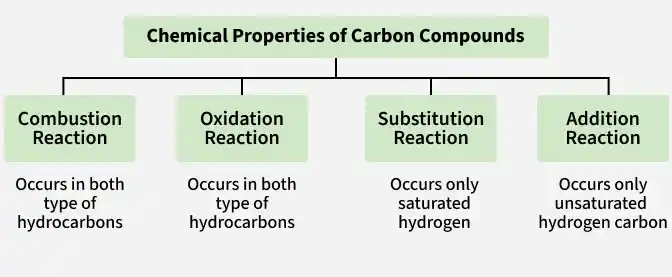
The chemical properties of carbon compounds mainly include reactions such as combustion, oxidation, addition reactions, and substitution reactions. These reactions are commonly observed in many organic compounds and are important in both natural processes and industrial applications.
The main types of chemical reactions shown by carbon compounds are:
1) Combustion Reaction
Example: methane burns in oxygen to form carbon dioxide and water.
CH4 + 2O2 → CO2 + 2H2O + Heat
This reaction releases energy, which is why methane is commonly used as a fuel for cooking and heating.
2) Oxidation Reaction
Example: ethanol can be oxidized to form ethanoic acid.
CH3CH2OH + [O] → CH3COOH + H2O
This reaction shows how alcohol can be converted into an acid through oxidation.
3) Substitution Reaction
Example: methane reacts with chlorine in the presence of sunlight to form chloromethane.
CH4 + Cl2 → CH3Cl + HCl
In this reaction, one hydrogen atom of methane is replaced by a chlorine atom.
4) Addition Reaction
Example: hydrogen can add to ethene to form ethane in the presence of a catalyst such as nickel or palladium.
CH2=CH2 + H2 → CH3-CH3
This reaction is called hydrogenation and is used in the food industry to convert vegetable oils into solid fats.