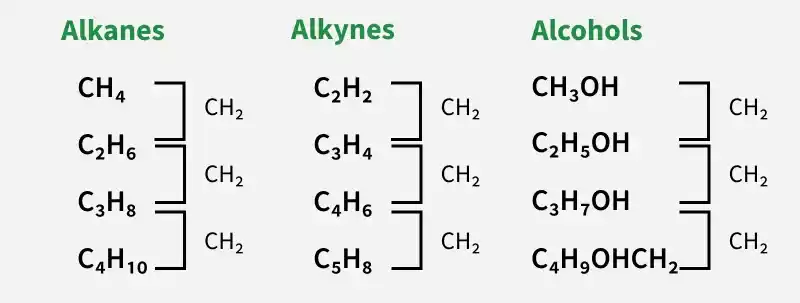
A homologous series is a group of organic compounds that have similar chemical structures and properties. All the compounds in a series contain the same functional group and follow a common general formula. The members of a homologous series differ from each other by a –CH2 (methylene) group, which means that the molecular mass increases gradually from one member to the next.
Example: The alkane homologous series includes methane (CH4), ethane (C2H6), propane (C3H8), and butane (C4H10)
A homologous series has several important characteristics that help in identifying and studying organic compounds.
1) Same Functional Group
All the compounds in a homologous series contain the same functional group.
Because of this, they show similar chemical properties.
Example: Alcohols contain the –OH functional group, such as methanol (CH3OH) and ethanol (C2H5OH).
2) Same General Formula
Members of a homologous series follow the same general formula.
Example: Alkanes follow the general formula:
CnH2n+2
Methane (CH4), Ethane (C2H6), and Propane (C3H8) all follow this formula.
3) Difference of –CH2 Group
Each successive member of a homologous series differs from the previous member by a –CH₂ group.
Example:
Methane (CH4), Ethane(C2H6)
Here each compound increases by –CH2.
4) Gradual Change in Physical Properties The physical properties such as boiling point, melting point, and density change gradually as the molecular mass increases.
Example:
Boiling point increases from methane to ethane to propane.
5) Similar Chemical Properties Since all members have the same functional group, they undergo similar chemical reactions.
Example:
Alcohols like methanol and ethanol both react with sodium to form hydrogen gas.
Formula for Homologous Series
A homologous series is a collection of organic compounds that have a general formula but are distinguished from one another by recurrent structural units. The following may be expressed as an equation:
General Formula: R - X
R is Remainder of Molecule, or Main Carbon Chain
X is Functional Group that establishes Series
In the alkane series, for instance, the usual formula is CnH2n+2. Every series member varies from the others by one CH2 unit.
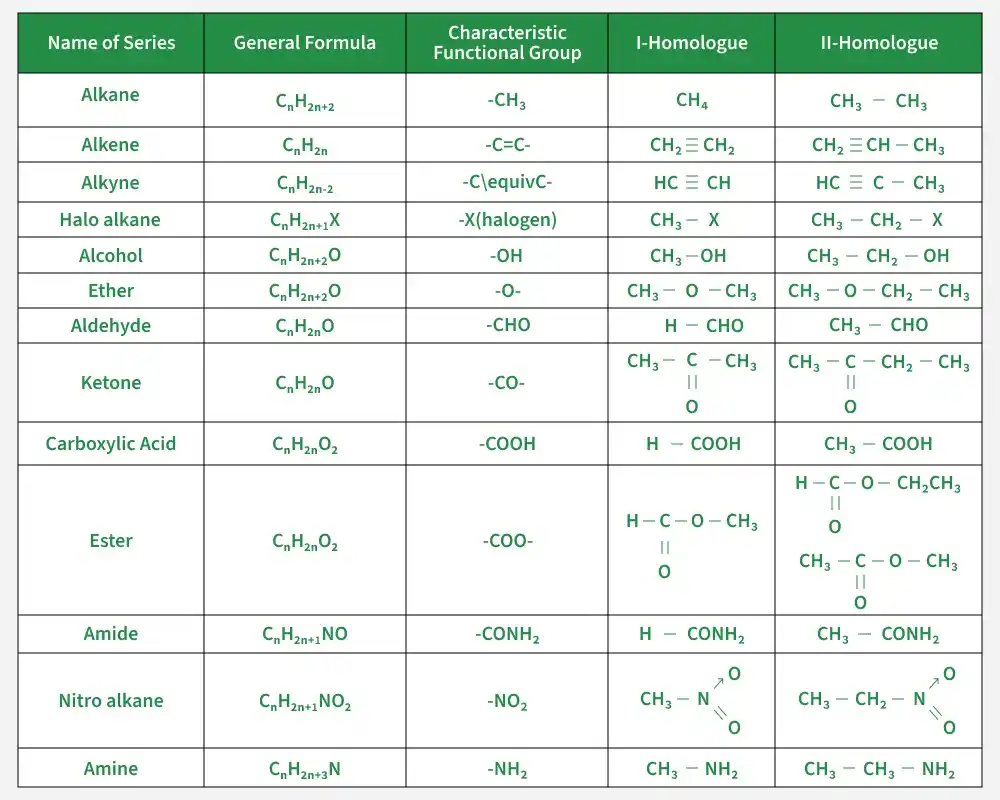
Homologous Series Table
The following table shows some members of a homologous series, illustrating how the molecular formula increases gradually while maintaining the same functional group and general formula.
Numerous organic molecules fall under the homologous series category; they are all distinguished by unique structural and chemical characteristics. Common homologous series include the following:
1) Alkane Homologous Series
Alkane are saturated hydrocarbons that contain only single covalent bonds between carbon atoms.
Because all carbon atoms are connected by single bonds, alkanes are considered the simplest type of hydrocarbons.
In the alkane homologous series, each compound differs from the next by a –CH₂ group.
Alkynes are unsaturated hydrocarbons that contain at least one triple bond between two carbon atoms (C≡C).
Because of the presence of a triple bond, alkynes are generally more reactive than alkanes and alkenes.
Like other homologous series, the members of the alkyne series have similar chemical properties and follow a common general formula.
The general formula of alkynes is: CnH2n-2
In the alkyne homologous series, each successive member differs from the previous one by a –CH₂ group.
As the number of carbon atoms increases, the molecular mass and physical properties such as boiling point and melting point gradually increase.
Examples:
Ethyne (Acetylene) (C2H2)
Propyne (C3H4)
Butyne (C4H6)
4) Alcohols Homologous Series
Alcohols are organic compounds that contain a hydroxyl functional group (–OH) attached to a carbon atom.
Alcohols form an important homologous series in organic chemistry because all members contain the same –OH functional group and show similar chemical properties.
The general formula of alcohols is: CnH2n+1OH
In the alcohol homologous series, each successive member differs from the previous one by a –CH₂ group, just like other homologous series.
As the molecular size increases, the boiling point, melting point, and density gradually increase.
Aldehydes are organic compounds that contain the aldehyde functional group (–CHO).
In this group, a carbon atom is double bonded to an oxygen atom and single bonded to a hydrogen atom.
Aldehydes form an important homologous series in organic chemistry because all members contain the same functional group (–CHO) and show similar chemical properties.
The general formula of aldehydes is: CnH2nO
In the aldehyde homologous series, each successive member differs from the previous one by a –CH₂ group.
As the number of carbon atoms increases, the molecular mass and physical properties such as boiling point and melting point gradually increase.
Amines are organic compounds that contain the amino functional group (–NH₂).
They are considered derivatives of ammonia (NH₃) in which one or more hydrogen atoms are replaced by alkyl groups.
Amines form a homologous series because all members contain the same functional group (–NH₂) and show similar chemical properties.
The general formula of primary amines is: CnH2n+1NH2
In the amine homologous series, each successive member differs from the previous one by a –CH₂ group, leading to gradual changes in physical properties such as boiling point and molecular mass.