|
VOOZH | about |
|
VOOZH | about |
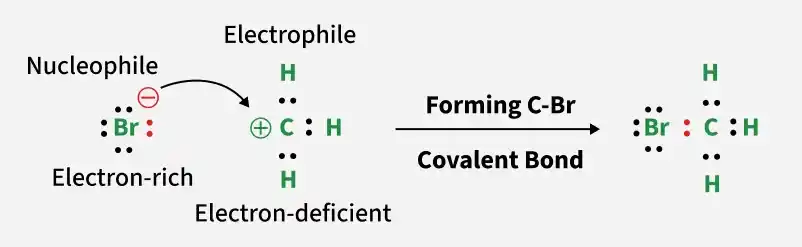
Organic reactions involve the interaction of chemical species through the transfer or sharing of electrons. Some species are rich in electrons, while others are deficient in electrons. Based on their tendency to donate or accept electron pairs, these species are classified as nucleophiles and electrophiles. Nucleophiles are electron-rich and donate electrons, whereas electrophiles are electron-deficient and accept electrons.
Electrophiles are chemical species that are electron-deficient and have a tendency to accept a pair of electrons to form a covalent bond. They are called “electron-loving” species because they are attracted towards regions of high electron density. Electrophiles behave as Lewis acids because they accept electron pairs.
These species also show common characteristics due to their tendency to accept electrons.
On the basis of their nature and charge, electrophiles are of different types:
These electrophiles carry a complete positive charge and are highly electron-deficient. Due to this, they strongly attract electrons. Since they already have a positive charge, they readily accept electrons to achieve stability.
Examples:
- H⁺ (proton)
- NO2⁺ (nitronium ion)
- Carbocations like CH3⁺, C2H5⁺
These are uncharged molecules but still act as electrophiles because they have incomplete octet or electron deficiency. Atoms like boron or aluminium have only 6 electrons in their outer shell, so they can accept electron pairs.
Examples:
- BF3 (boron trifluoride)
- AlCl3 (aluminium chloride)
Some neutral molecules act as electrophiles due to the presence of a polar bond, where one atom carries a partial positive charge (δ⁺). The atom with partial positive charge becomes electron-deficient and behaves as an electrophile.
Examples:
- H–Cl (H acts as electrophile)
- R–Br (carbon acts as electrophile)
Nucleophiles are chemical species that are electron-rich and have a tendency to donate a pair of electrons to form a covalent bond. They are called “nucleus-loving” because they are attracted towards positively charged or electron-deficient centres. Nucleophiles behave as Lewis bases since they donate electron pairs.
On the basis of charge and availability of electrons, nucleophiles are of different types and show specific characteristics.
Depending upon the presence of charge, lone pairs, or π electrons, nucleophiles are classified into various types.
These nucleophiles carry a negative charge and have high electron density. Because of the extra electron(s), they can easily donate a pair of electrons.
Examples:
- OH⁻ (hydroxide ion)
- CN⁻ (cyanide ion)
- Cl⁻, Br⁻, I⁻ (halide ions)
These are neutral molecules but contain lone pairs of electrons which they can donate. Even without charge, lone pairs make them capable of acting as nucleophiles.
Examples:
- NH3 (ammonia)
- H2O (water)
- ROH (alcohols)
Some nucleophiles have π (pi) electrons instead of lone pairs. These π electrons can be donated to electrophiles.
Examples:
- Alkenes (C=C double bond)
- Benzene (aromatic ring)
Examples: OH⁻, CN⁻, I⁻
Examples: H2O, ROH
The key differences between Electrophile and Nucleophile are listed in the following table:
| Electrophiles | Nucleophiles |
|---|---|
| Electrophiles are electron-deficient species. | Nucleophiles are electron-rich species. |
| They accept a pair of electrons to form a bond. | They donate a pair of electrons to form a bond. |
| They are attracted towards electron-rich centers. | They are attracted towards electron-deficient or positive centers. |
| They generally carry a positive charge or partial positive charge. | They generally carry a negative charge or have lone pairs/π electrons. |
| They act as Lewis acids (electron pair acceptors). | They act as Lewis bases (electron pair donors). |
| Examples: H⁺, NO2⁺, BF3 | Examples: OH⁻, CN⁻, NH3, H2O |