|
VOOZH | about |
|
VOOZH | about |
Esterification is the chemical process in which alcohol (ROH) reacts with specific acids, predominantly carboxylic acid (RCOOH), to form an ester (RCOOR). An ester is a chemical compound which is having two carbon groups bonded to a single oxygen atom.
In this article, we are going to learn about the process of esterification, exploring its mechanism, techniques, applications, conditions, and examples, along with common frequently asked questions (FAQs).
Table of Content
Esterification can be defined as a chemical reaction that forms at least one ester product. It can also be understood as the process of combining an organic acid with alcohol to form an ester and water. Here, alcohol and carboxylic acid undergo an esterification reaction that forms the ester.
The chemical reaction for esterification can be understood by the image given below:
An ester is formed when primary alcohol and carboxylic acid are heated together with the assistance of an acid catalyst. The acid catalyst used in the process is usually sulphuric acid and in other cases, dry hydrogen gas can be used. The compound that is obtained here is known as an ester. The esterification reaction is the name given to the chemical process that results in the formation of the ester.
CH3COOH + CH3CH2COOH → CH3COOCH2CH3
Esterification proceeds in several steps. The mechanism of esterification is shown below:
Step 1: Formation of cation
👁 Esterification Mechanism Step 1
Step 2: Here, a delocalized carbocation is formed as a result of protonating the carboxyl oxygen. This, in turn, makes the carbocation a better electrophile.
👁 Esterification Mechanism Step 2
Step 3: In this step, a proton is then transferred to one of the hydroxyl groups to create a suitable leaving group.
👁 Esterification Mechanism Step 3
Step 4: Here, the carbon atom forms a π bond by removing water after the alcohol oxygen atom of the hydroxy group delivers a pair of electrons to it. Since the concentration of water is lower than that of methanol, this is not a suitable nucleophile for reversing the reaction.
👁 Esterification Reaction Step 4
Step 5: In the final step, the concentration of water is too low to reverse the entire reaction.
👁 Esterification Reaction Step 5
There are various methods present for preparing esters in laboratories. Some of these methods are discussed below:
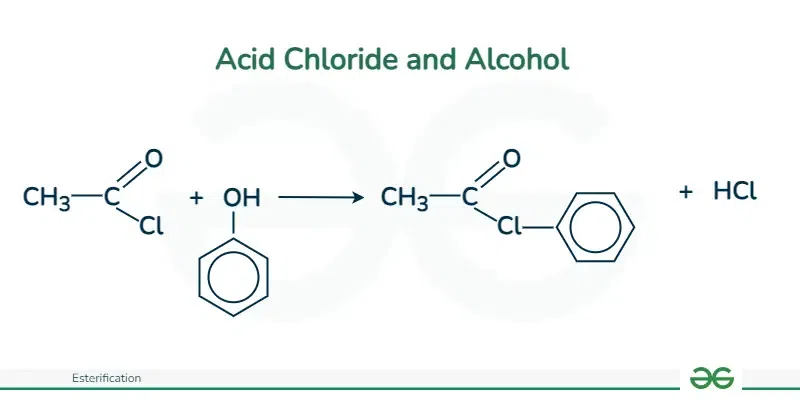
When acyl chloride reacts with alcohol, its resulting reaction can be quite violent at room temperature. This reaction produces an ester along with hydrogen chloride gas’s acidic fumes.
👁 Esterification by Acid Chloride and Alcohol
For example, when liquid acetyl chloride is introduced to ethanol, it produces hydrogen chloride fumes which results in forming ethyl ethanoate, which is an ester.
Both phenols and alcohols react when we use this approach. When it comes to phenols, there are situations when changing phenol into a more reactive form beforehand may enhance the reaction.
Acetyl chloride also reacts with phenol in a similar way to the ethanol reaction, but here reaction is comparatively less intense. This reaction produces phenyl ethanoate and hydrogen chloride gas.
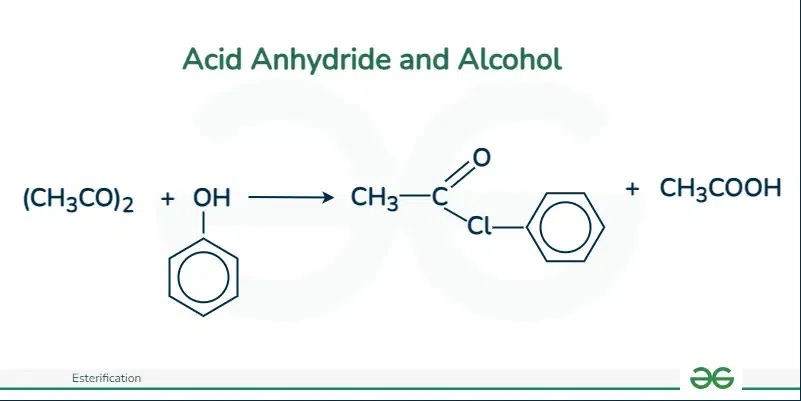
The reaction between alcohol and acid anhydride is relatively slower in comparison to the reaction between an acid anhydride and acid chloride. The mixture needed to be warmed to obtain many esters.
👁 Formation of Ester by reaction between acid anhydride and alcohol
For example, the reaction between ethanol and ethanoic anhydride. Here the reaction is extremely slow at room temperature but speeds up on warming. Even though the colorless liquids seem unchanged, they actually form a mixture of ethyl acetate and acetic acid. A similar reaction takes place with phenol however more slowly.
This method is used for converting alcohols into esters. Here, esters are formed by heating carboxylic acids and alcohol together with the assistance of an acid catalyst.
👁 Formation of Ester by Carboxylic Acid and Alcohol
The catalyst that is commonly used is concentrated sulfuric acid. Sometimes, dry hydrogen chloride gas is used, but this is usually only for aromatic esters(carboxylic acid containing a benzene ring).
CH3COOH + CH3CH2OH ⇌ CH3COOCH2CH3 + H2O
Here, the ethanol and ethanoic acid react to form water and methyl-ethanoate.
The conditions that are required for esterification are as follows:
Understanding the properties of esters is important. Here are some key properties of esters:
Odor: Esters are known for their pleasant, fruity, and floral odors. They are commonly used in flavorings and perfumes.
Solubility: Esters are generally soluble in organic solvents but they have limited solubility in water due to their non-polar nature.
Boiling Point: The boiling points of esters are typically lower in comparison to the alcohols and acids of similar molecular weight.
Reactivity: Ester reacts when they come into interaction with a base or an acid. This reaction results in forming both the alcohol and the carboxylic acid and is known as saponification.
Flammability: Esters are flammable compounds and they can form explosive mixtures with air.
Esters are used in many different ways which are as follows:
Following are the examples of esters:
Esterification is the reaction of preparation of ester while saponification is the reaction of preparation of soap. The difference between esterification and saponification is tabulated below:
Aspect | Esterification | Saponification |
|---|---|---|
Definition | Esterification refers to the chemical process that results in the formation of an ester. | Saponification refers to the chemical process that results in the formation of soap. |
Reactants | Reaction takes place in the presence of alcohol and carboxylic Acid. | Reaction takes place in the presence of ester and alkaline (usually a strong base). |
Catalyst | Requires acid catalyst. | Requires base catalyst. |
Reaction Condition | Typically requires heat to proceed, though the conditions can vary. | Requires an aqueous alkaline environment and often heat for the reaction. |
Usage | Esters with fragrances are used in food, cosmetics, and perfumes. | Saponification is used to form soaps that are having various characteristics. |
Reversibility | It is a reversible reaction. | It is an irreversible reaction. |
We have learned in this article that esterification is a fundamental chemical process that involves the formation of esters by the reaction between alcohol and carboxylic acid. This process requires acid catalyst. It has various methods and conditions for its execution. Understanding the properties, uses, mechanism, and examples of esters is important for students, So that they can apply it practically in various industries like materials science, food, pharmaceuticals, and cosmetics.
Related Articles