|
VOOZH | about |
|
VOOZH | about |
In organic chemistry, alkenes undergo addition reactions in which atoms or groups are added across the double bond. In the case of unsymmetrical alkenes, the addition of reagents like hydrogen halides (HX) can lead to the formation of more than one product. To predict the major product formed in such reactions, Markovnikov’s rule is used.
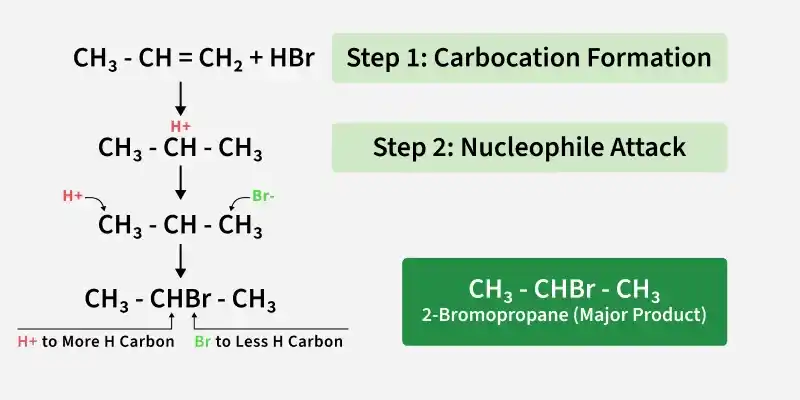
The addition of hydrogen halides (HX) to alkenes occurs through a two-step electrophilic addition mechanism involving the formation of a carbocation intermediate.
Step 1: Formation of Carbocation (Slow Step)
The double bond in an alkene is rich in electrons and acts as a nucleophile. It attacks the hydrogen (H⁺) of HX. The hydrogen atom adds to one of the carbon atoms of the double bond. This leads to the formation of a carbocation on the other carbon atom.
Step 2: Attack of Nucleophile (Fast Step)
Example 1: Addition of HBr to Propene
CH3–CH=CH2 + HBr → CH3–CHBr–CH3
Example 2: Addition of HCl to Propene
CH3–CH=CH2 + HCl → CH3–CHCl–CH3
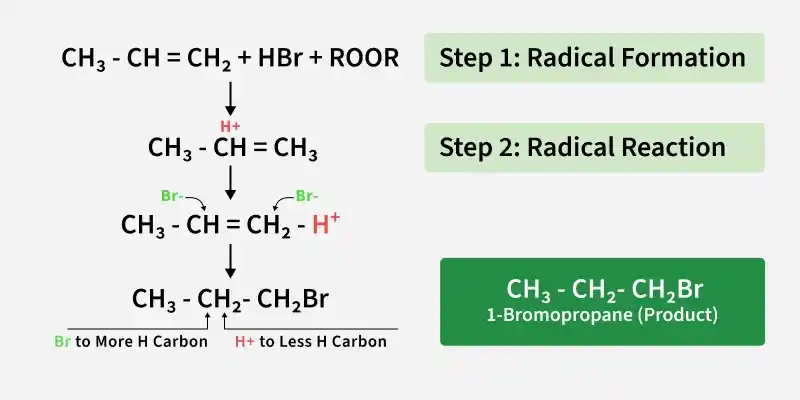
In certain conditions, the addition of hydrogen bromide (HBr) to an unsymmetrical alkene takes place opposite to Markovnikov’s rule. This is known as the anti-Markovnikov rule. In this case, In presence of peroxides, Br attaches to the carbon with more hydrogen atoms due to free radical mechanism, while hydrogen attaches to the carbon having fewer hydrogen atoms.
Example: Addition of HBr to Propene (in presence of peroxide)
CH3–CH=CH2 + HBr → CH3–CH2–CH2Br
| Markovnikov Addition | Anti-Markovnikov Addition |
|---|---|
| Hydrogen attaches to the carbon having more hydrogen atoms. | Hydrogen attaches to the carbon having fewer hydrogen atoms. |
| Halide (X) attaches to the carbon having fewer hydrogen atoms. | Halide (X) attaches to the carbon having more hydrogen atoms. |
| Occurs under normal conditions. | Occurs in the presence of peroxides. |
| Proceeds through a carbocation intermediate. | Proceeds through a free radical mechanism. |
| Follows stability of carbocation. | Does not involve carbocation formation. |
| Observed with HX (HCl, HBr, HI). | Observed only with HBr (peroxide effect). |