|
VOOZH | about |
|
VOOZH | about |
Nitration is an electrophilic substitution reaction of aromatic hydrocarbons in which a nitro group (–NO2) is introduced into the aromatic ring by replacing a hydrogen atom. It is carried out using a mixture of concentrated nitric acid and sulphuric acid, which generates the active electrophile. Due to the stability of the aromatic ring, the reaction proceeds by substitution rather than addition, thereby preserving aromaticity.
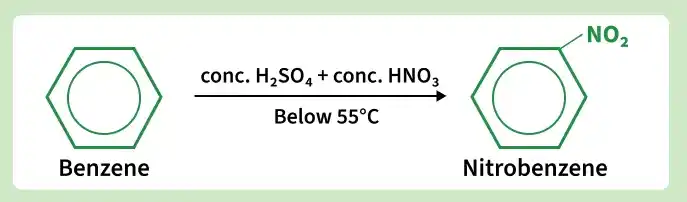
Nitration is carried out using a mixture of concentrated nitric acid (HNO3) and concentrated sulphuric acid (H₂SO₄), commonly known as the nitrating mixture. Both acids play specific roles in the reaction.
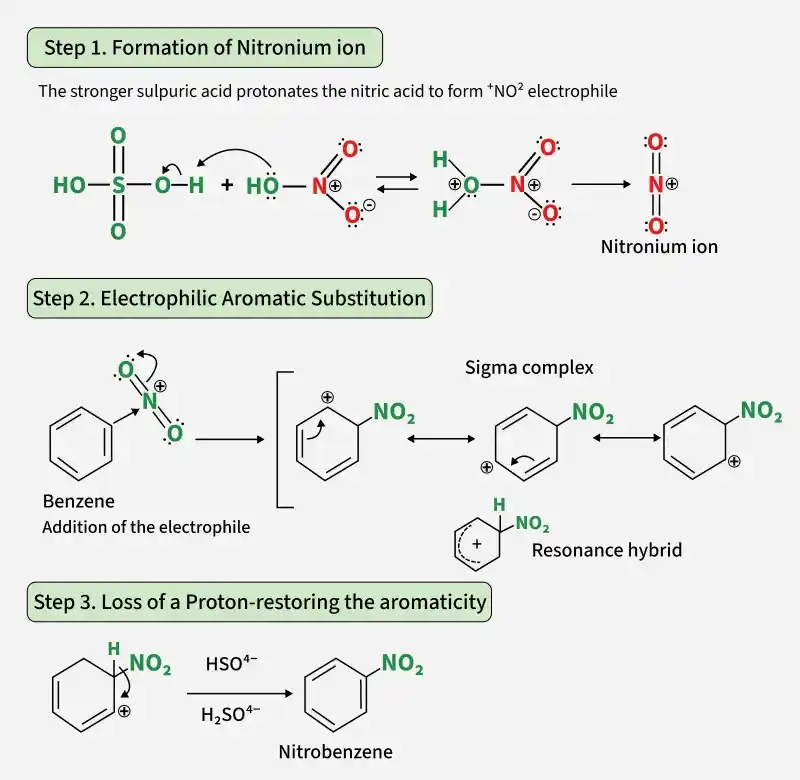
In the nitration reaction, the active electrophile is the nitronium ion (NO2⁺). It is generated from the nitrating mixture of concentrated nitric acid and concentrated sulphuric acid.
HNO3 + H2SO4 → NO2+ + HSO4-+ H2O
Nitration of aromatic hydrocarbons follows the electrophilic substitution mechanism, in which the nitronium ion (NO2+) attacks the benzene ring.
The nitronium ion (NO2+), which is a strong electrophile, attacks the electron-rich benzene ring. This results in the formation of an unstable intermediate called the arenium ion (σ-complex). In this step, the aromaticity of benzene is temporarily lost.
The intermediate formed is resonance-stabilised, where the positive charge is delocalised over the ring. However, it is still less stable than benzene.
A base (HSO4⁻) removes a hydrogen ion (H⁺) from the intermediate. This restores the aromaticity of the ring and forms the final product, nitrobenzene.
In nitration, benzene reacts with concentrated nitric acid (HNO3) in the presence of concentrated sulphuric acid (H2SO4) to form nitrobenzene.