|
VOOZH | about |
|
VOOZH | about |
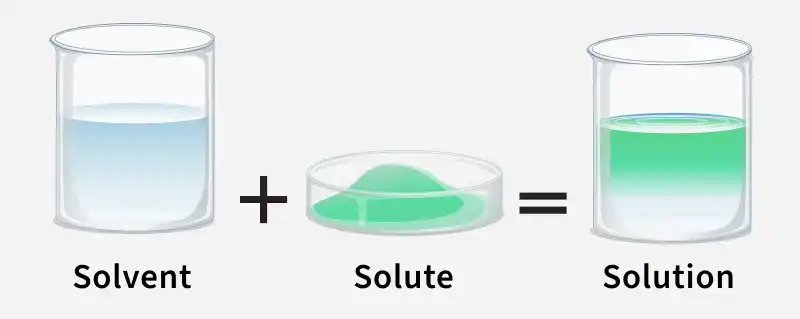
Solubility is defined as the amount of solute required to form a saturated solution in a given amount of solvent at a specific temperature. When a solute is added to a solvent it dissolves up to a certain limit after that, no more solute dissolves this point is called saturation.
👁 soluteThe solubility product (Ksp) is a constant value that represents this equilibrium. The product of the concentrations of the ions present in a saturated solution, each raised to the power of their coefficients.
Example:
AgCl (s) ⇌ Ag⁺ (aq) + Cl⁻ (aq)
Ksp = [Ag⁺] [Cl⁻]
At equilibrium:
- Solid AgCl is present
- Ions (Ag⁺ and Cl⁻) are present in solution
The solubility product (Ksp) is written using the balanced chemical equation of the dissociation of a sparingly soluble salt. Ksp is product of concentrations of ions, each raised to the power of its coefficient.
For a salt:
AxBy (s) ⇌ xA y+ (aq) + yB x- (aq)
The Ksp expression is:
Ksp = [Ay+] x [Bx-] y
The solubility product (Ksp) is very useful in understanding the behavior of sparingly soluble salts in solutions. It has several important applications in chemistry.
Ksp is defined as the product of the molar concentrations of the ions in a saturated solution, each raised to the power of their stoichiometric coefficients, at a given temperature.
Example:
AgCl (s) ⇌ Ag⁺ (aq) + Cl⁻ (aq)
Ksp = [Ag⁺] [Cl⁻]
To calculate Ksp, follow these steps:
Step 1: Write the Dissociation Equation
Write the balanced chemical equation of the salt dissolving in water.
Example:
CaF2 (s) ⇌ Ca2+ (aq) + 2F-(aq)
Step 2: Assume Solubility (s)
Let the solubility of the salt = s mol/L. It means Amount of salt dissolved = s
Step 3: Write Ion Concentrations
Use the equation to express ion concentrations in terms of s.
Example:
For CaF₂:
- [Ca 2+] = s
- [F -] = 2s
Step 4: Write Ksp Expression
Ksp = product of ion concentrations (with powers)
For CaF2:
Ksp = [Ca2+] [F -] 2
Step 5: Substitute Values
Put the values in terms of s:
Ksp = s × (2s) 2
Ksp = 4s 3
Step 6: Calculate Ksp
The solubility (s) of a salt is directly related to its solubility product (Ksp). This relation depends on how the salt dissociates. The relation depends on the number of ions formed. Higher powers of s appear when more ions are produced
Using this relation, we can:
Examples:
For 1 : 1 Electrolyte
AgCl ⇌ Ag⁺ + Cl⁻
Ksp = s2
Relation:
s = √Ksp
Example 1: Calculate the solubility product constant for silver chloride (AgCl) given that the concentration of Ag+ ions is 1.5×10 −5M and Cl− ions is 2.0×10⁻⁵M.
Solution:
Ksp = [Ag+]×[Cl-]
Ksp = (1.5×10−5)×(2.0×10−5)
Ksp = 3.0×10 −10
Example 2: Calculate the Molar Solubility for calcium hydroxide (Ca(OH)2) given that the solubility product constant for calcium hydroxide is 6.7 X 10⁻⁶
Solution:
Ca(OH)2 = Ca 2+ + 2OH -
Ksp = [Ca 2+]+[OH -] 2
Let x be molar solubility and Ca2+ = x and OH -= 2x
6.7 × 10 -6= 4x 3
Now substitute x
x3= 6.7 × 10 -6 /4
x = 0.012 M (approx)
Example 3: Calculate the solubility product constant for silver chloride (AgCl) given that the concentration of Ag+ ions is 0.5×10 −6M and Cl− ions is 3.0×10⁻⁹M.
Solution:
Ksp =[Ag+]×[Cl-]
Ksp =( 0.5×10 −6M)×(3.0×10⁻⁹M)
Ksp = 1.5 x 10 -15
Example 4:How to Calculate Solubility Product Constant? Demystify the calculation of Ksp with an example. Consider silver chloride (AgCl) with [Ag+]=2.4×10⁻⁵M and [Cl-]=1.0×10⁻⁵M.
Solution:
Ksp = Ag + × Cl -
Ksp = (2.4×10−5)×(1.0×10−5)
Ksp = 2.4×10⁻¹⁰