Python magic (dunder) methods are special methods with double underscores __ that enable operator overloading and custom object behavior.
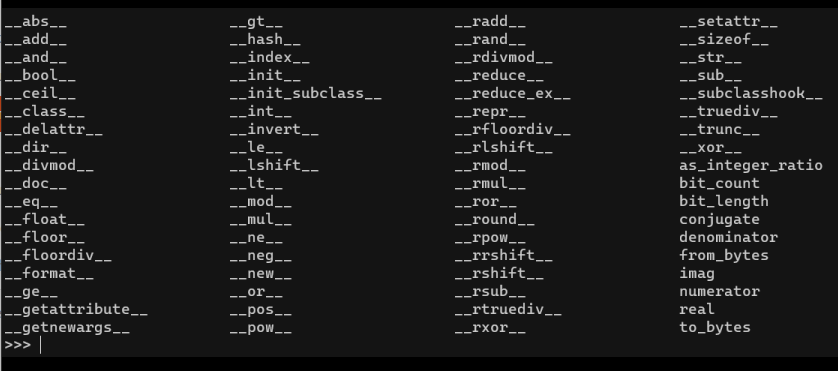
The below code displays the magic methods inherited by int class.
Output['__abs__', '__add__', '__and__', '__bool__', '__ceil__', '__class__', '__delattr__', '__dir__', '__divmod__', '__doc__', '__eq__', '__float__', '__floor__', '__floordiv__', '__format__', '__ge__', '_...
Explanation: dir(int) lists all attributes and methods of the int class, including magic (dunder) methods like __add__, __str__, etc.
You can list magic (dunder) methods for any Python object via the terminal by following these steps:
- Open the terminal or command prompt and type python3 to enter the Python console.
- Use the dir() function to list all methods, e.g.
>>> dir(int)
Output
👁 Magic methods in PythonPython Magic Methods
Below are the lists of Python magic methods and their uses.
1. Initialization and Construction
- __new__: To get called in an object's instantiation.
- __init__: To get called by the __new__ method.
- __del__: It is the destructor.
2. Numeric magic methods
- __trunc__(self): Implements behavior for math.trunc()
- __round__(self,n): Implements behavior for the built-in round()
- __abs__(self): Implements behavior for the built-in abs()
- __neg__(self): Implements behavior for negation
- __pos__(self): Implements behavior for unary positive
3. Arithmetic operators
- __add__(self, other): Implements behavior for the + operator (addition).
- __sub__(self, other): Implements behavior for the - operator (subtraction).
- __mul__(self, other): Implements behavior for the * operator (multiplication).
- __truediv__(self, other): Implements behavior for the / operator (true division).
- __mod__(self, other): Implements behavior for the % operator (modulus).
4. String Magic Methods
- __str__(self): Defines behavior for when str() is called on an instance of your class.
- __repr__(self): To get called by built-int repr() method to return a machine readable representation of a type.
- __hash__(self): It has to return an integer, and its result is used for quick key comparison in dictionaries.
- __bool__(self): Returns True or False to determine the truth value of an object, used in conditions and bool() calls.
- __dir__(self): This method to return a list of attributes of a class.
5. Comparison magic methods
- __eq__(self, other): Defines behavior for the equality operator, ==.
- __ne__(self, other): Defines behavior for the inequality operator, !=.
- __lt__(self, other): Defines behavior for the less-than operator, <.
- __gt__(self, other): Defines behavior for the greater-than operator, >.
- __ge__(self, other): Defines behavior for the greater-than-or-equal-to operator, >=.
Examples of Magic Methods
1. __init__ Method
__init__ method is automatically called when a new instance of a class is created. It is used to initialize the object’s attributes, similar to constructors in languages like C++, Java, C#, or PHP.
Output<__main__.String object at 0x791ce72aa900>
Explanation:
- __init__(self, string): Constructor that initializes the object with a string.
- s1= String('Hello'): Creates an instance of String with 'Hello'.
- print(s1): Tries to print the object.
2. __repr__ method
__repr__ method defines the official string representation of an object, primarily used for debugging. By default, it shows the type and memory address of the object.
Explanation:
- __repr__(self): Returns the official string representation of the object; used when printing or debugging.
- str1 = String('Hello'): Creates an instance of String with 'Hello'.
3. __add__ method
__add__ method method defines how objects of a class are added together using the '+' operator. It allows operator overloading.
Adding __add__ method to String class: