|
VOOZH | about |
|
VOOZH | about |
Chordal graphs, also known as triangulated graphs, are a class of undirected graphs characterized by the absence of "induced cycles" of length greater than three. This means that in a chordal graph, any cycle of four or more vertices must have an additional edge (chord) connecting two non-consecutive vertices within the cycle. This property makes chordal graphs simpler to work with in several computational and theoretical settings.
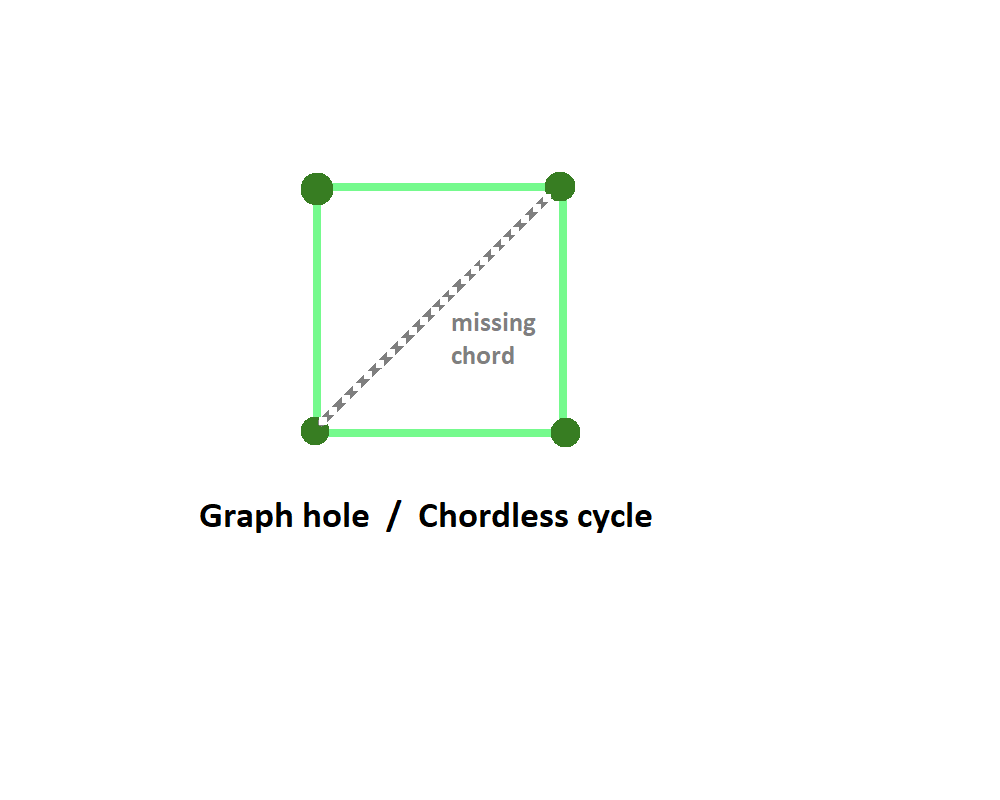
A chordal graph is a special type of undirected simple graph. A graph is chordal if and only if every induced cycle of length 4 or more is such that any two non-adjacent vertices of the cycle are connected as a chord or edge. That chord is not part of the graph cycle. A graph cycle without a chord is called a "graph hole" or "chordless cycle."
A chord divides a cycle into two parts. If at least one of the cycles is not a cycle, then it has another chord.
There are several important subclasses of graphs, and all have their own properties and applications. Some of the most important are mentioned below.
A complete graph is a chordal graph, in which every vertex is connected to adjacent vertices. Every vertex has the same degree. A complete graph is a superset of a chordal graph. because every induced subgraph of a graph is also a chordal graph.
An interval graph is a chordal graph that can be represented by a set of intervals on a line such that two intervals have an intersection if and only if the corresponding vertices in the graph are adjacent.
A block graph is a chordal graph where every block (maximal 2 connected subgraphs) is a complete graph.
A clique-sum graph is a chordal graph that can be constructed by sequences of operations called clique-sum. where two graphs are merged by identifying a common clique.
A Perfect Elimination Graph is a chordal graph in which each induced subgraph has a perfect elimination ordering, which is an ordering of vertices in which every vertex is adjacent to every later vertex in the ordering that is also a neighbor of the vertex.
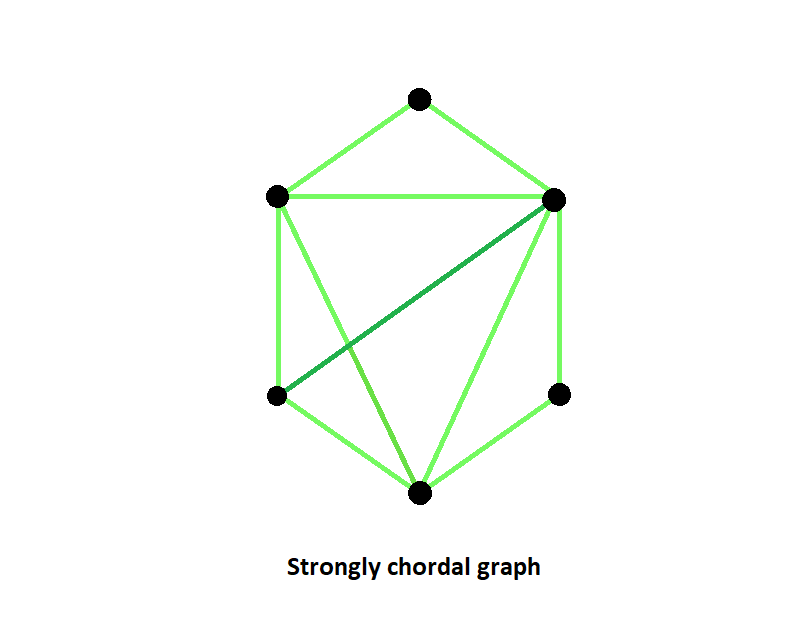
A strongly chordal graph is a chordal graph in which every induced subgraph has a perfect elimination ordering. That is, there exists an ordering of the vertices such that, for each vertex, its neighbors that come later in the ordering form a clique.
Some of the properties of Chordal graph are:
Chordal graphs can be characterized in several ways:
Problem: Determine if the following graph is chordal. Vertices: {A, B, C, D, E} Edges: {(A, B), (A, C), (B, C), (B, D), (C, D), (C, E), (D, E)}
Solution:
List all cycles in the graph.
Cycle 1: A-B-C-A (triangle, no need to check further)
Cycle 2: B-C-D-B (triangle, no need to check further)
Cycle 3: C-D-E-C (triangle, no need to check further)
Cycle 4: A-B-C-D-A (has length 4)
Checking if there is a chord in the cycle of length 4.
In cycle A-B-C-D-A, the chord is B-D.
Since all cycles of length 4 or more have chords, the graph is chordal.
Problem: Add edges to the following graph to make it chordal. Vertices: {A, B, C, D, E} Edges: {(A, B), (B, C), (C, D), (D, E)}
Solution:
Identify cycles of length 4 or more.
Cycle 1: A-B-C-D-E-A (length 5)
Add edges to create chords in the cycle.
Adding edge A-C breaks the cycle A-B-C-D-E-A into two cycles: A-B-C-A and A-C-D-E-A.
The modified graph is now chordal.
Problem: Find a perfect elimination ordering for the following graph. Vertices: {A, B, C, D} Edges: {(A, B), (A, C), (B, C), (B, D)}
Solution:
Select a vertex with the least number of neighbors.
Vertex A has two neighbors (B, C).
Remove vertex A and its edges, and select the next vertex with the least number of neighbors.
Remove A. The remaining graph has vertices {B, C, D} with edges {(B, C), (B, D)}.
Continue this process.
Remove C. The remaining graph has vertices {B, D} with edge {(B, D)}.
Remove D. The remaining graph has vertex {B}.
The perfect elimination ordering is (A, C, D, B).
Problem 1: Determine if the following graph is chordal. Vertices: {A, B, C, D, E} Edges: {(A, B), (B, C), (C, D), (D, E), (E, A)}
Problem 2: Add edges to make the following graph chordal. Vertices: {A, B, C, D} Edges: {(A, B), (B, C), (C, D)}
Problem 3: Find a perfect elimination ordering for the following graph. Vertices: {A, B, C, D, E} Edges: {(A, B), (A, C), (A, D), (B, C), (B, D), (C, D), (C, E)}
Problem 4: Verify if the given graph is chordal. Vertices: {A, B, C, D, E, F} Edges: {(A, B), (A, C), (B, C), (B, D), (C, D), (D, E), (E, F)}
Problem 5: Add edges to make the following graph chordal. Vertices: {A, B, C, D, E, F} Edges: {(A, B), (B, C), (C, D), (D, E), (E, F), (F, A)}
Problem 6: Find a perfect elimination ordering for the following graph. Vertices: {A, B, C, D, E} Edges: {(A, B), (A, D), (B, C), (C, D), (D, E)}
Problem 7: What is Chordal Graphs? Determine if the following graph is chordal. Vertices: {A, B, C, D} Edges: {(A, B), (B, C), (C, D), (A, D)}
Problem 8: Add edges to make the following graph chordal. Vertices: {A, B, C, D, E} Edges: {(A, B), (B, C), (C, D), (D, E), (A, E)}
Problem 9: Find a perfect elimination ordering for the following graph. Vertices: {A, B, C, D, E, F} Edges: {(A, B), (A, C), (B, C), (C, D), (D, E), (E, F)}
Problem 10: Verify if the given graph is chordal. Vertices: {A, B, C, D, E} Edges: {(A, B), (B, C), (C, D), (D, E), (E, A), (A, C)}
Related Articles