|
VOOZH | about |
|
VOOZH | about |
Convolutional neural networks (CNN's) are used to learn features as well as classify data with the help of image frames. There are many types of CNN's. One class of CNN's are depth wise separable convolutional neural networks. These type of CNN's are widely used because:
Some important applications of these type of CNN's are MobileNet and Xception. This article explains the architecture and operations used by depth wise separable convolutional networks and derives its efficiency over simple convolution neural networks.
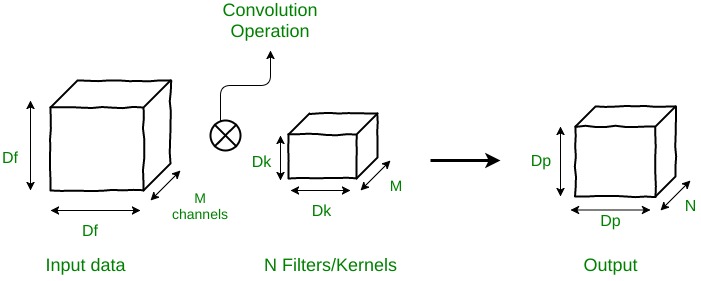
Suppose there is an input data of size Df x Df x M, where Df x Df can be the image size and M is the number of channels (3 for an RGB image). Suppose there are N filters/kernels of size Dk x Dk x M. If a normal convolution operation is done, then the output size will be Dp x Dp x N.
👁 ImageThe number of multiplications in 1 convolution operation = size of filter = Dk x Dk x M
Since there are N filters and each filter slides vertically and horizontally Dp times,
the total number of multiplications become N x Dp x Dp x (Multiplications per convolution)
So for normal convolution operation:
Total no of multiplications = N x Dp2 x Dk2 x M
Now look at depth-wise separable convolutions. This process is broken down into 2 operations:
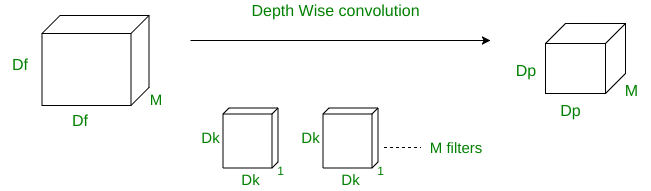
In depth-wise operation, convolution is applied to a single channel at a time unlike standard CNN's in which it is done for all the M channels. So here the filters/kernels will be of size Dk x Dk x 1. Given there are M channels in the input data, then M such filters are required. Output will be of size Dp x Dp x M. 👁 Image
Cost of this operation:
A single convolution operation require Dk x Dk multiplications.
Since the filter are slided by Dp x Dp times across all the M channels,
the total number of multiplications is equal to M x Dp x Dp x Dk x Dk
So for depth wise convolution operation:
Total no of multiplications = M x Dk2 x Dp2
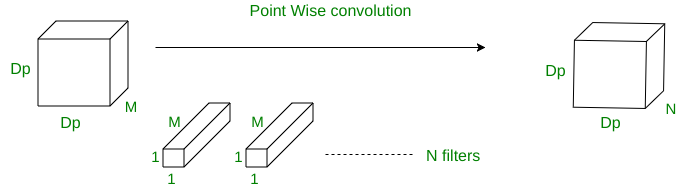
In point-wise operation, a 1x1 convolution operation is applied on the M channels. So the filter size for this operation will be 1 x 1 x M. Say we use N such filters, the output size becomes Dp x Dp x N. 👁 Image
Cost of this operation:
A single convolution operation require 1 x M multiplications.
Since the filter is being slided by Dp x Dp times,
the total number of multiplications is equal to M x Dp x Dp x (no. of filters)
So for point wise convolution operation
Total no of multiplications = M x Dp2 x N
Total multiplications = Depth wise conv. multiplications + Point wise conv. multiplications Total multiplications = M * Dk2 * Dp2 + M * Dp2 * N = M * Dp2 * (Dk2 + n)
So for depth wise separable convolution operation:
Total no of multiplications = M x Dp2 x (Dk2 + N)
Type of Convolution | Complexity |
|---|---|
Standard | N x Dp2 x Dg2 x M |
Depth wise separable | M x Dp2 x (Dk2 + N) |
Upon solving:
Ratio(R) = 1/N + 1/Dk2
As an example, consider N = 100 and Dk = 512. Then the ratio R = 0.010004 This means that the depth wise separable convolution network in this example, performs 100 times lesser multiplications as compared to a standard constitutional neural network. This tells that we can deploy faster convolution neural network models without losing much of the accuracy.