|
VOOZH | about |
|
VOOZH | about |
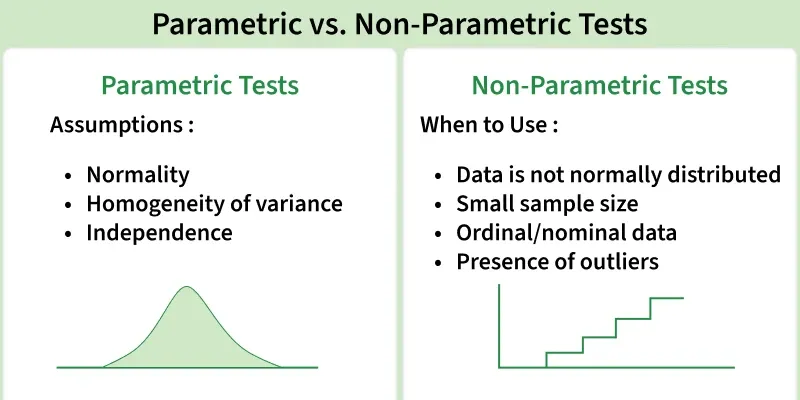
Parametric and non-parametric methods are two major approaches used in statistics and machine learning to model data and make predictions. Parametric methods assume a specific functional form for the underlying distribution and estimate a fixed set of parameters, while non-parametric methods make minimal assumptions and adapt their structure based on the data.
Parametric methods rely on the assumption that data follows a known and predefined mathematical form or distribution such as Gaussian, linear or exponential. These methods estimate a finite number of parameters that fully describe the model. Once these parameters are learned, the model’s structure does not change with additional data.
Non-parametric methods do not assume any fixed functional form for the data distribution. Instead, the model structure grows with the dataset, allowing for a high level of flexibility. These methods learn patterns directly from the data, making them suitable for complex or irregular relationships.
Let's see the difference between them:
| Aspect | Parametric Methods | Non-parametric Methods |
|---|---|---|
| Assumption about Data | Strong assumptions about the underlying distribution | Minimal or no assumptions about distribution |
| Model Structure | Fixed, defined by a finite set of parameters | Flexible, grows with data |
| Data Requirement | Require less data | Require large datasets to perform well |
| Computational Cost | Low (fast training and inference) | High (slower due to complexity) |
| Flexibility | Limited; may underfit complex patterns | High; capable of modeling non-linear relationships |
| Risk | High risk of model misspecification | High risk of overfitting if not regularized |
| Examples | Linear Regression, Logistic Regression, Naïve Bayes | KNN, Decision Trees, Random Forests, KDE |
| Best Used When | The distribution is known or approximates common forms | The distribution is unknown or patterns are complex |