|
VOOZH | about |
|
VOOZH | about |
One-Hot Encoding is a data preprocessing technique used to convert categorical data into a numerical format that machine learning models can understand. It creates separate binary columns for each category, where 1 represents the presence of a category and 0 represents its absence.
One-Hot Encoding creates a separate column for each category in the dataset. In the fruit example, when the fruit is Apple, the Fruit_Apple column gets the value 1 while the other fruit columns contain 0. Similarly, for Mango and Orange, their respective columns contain 1 and the remaining columns contain 0.
| Fruit | Categorical value of fruit | Price |
|---|---|---|
| apple | 1 | 5 |
| mango | 2 | 10 |
| apple | 1 | 15 |
| orange | 3 | 20 |
The output after applying one-hot encoding on the data is given as follows
| Fruit_apple | Fruit_mango | Fruit_orange | price |
|---|---|---|---|
| 1 | 0 | 0 | 5 |
| 0 | 1 | 0 | 10 |
| 1 | 0 | 0 | 15 |
| 0 | 0 | 1 | 20 |
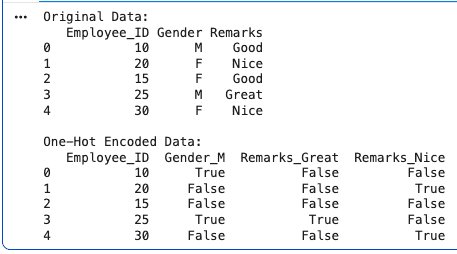
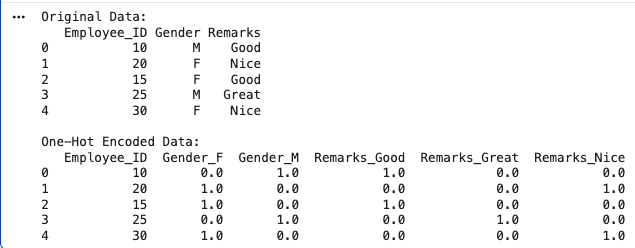
One-Hot Encoding can be implemented in Python using libraries such as Pandas and Scikit-learn, which provide simple and efficient methods for converting categorical data into binary columns.
Pandas provides the get_dummies() function to perform one-hot encoding on categorical columns.
Output:
Scikit-learn (sklearn) provides the OneHotEncoder function to convert categorical variables into binary columns for machine learning models.
Output:
Download full code from here