Stacking is a ensemble learning technique where the final model known as the “stacked model" combines the predictions from multiple base models. The goal is to create a stronger model by using different models and combining them.
Architecture of Stacking
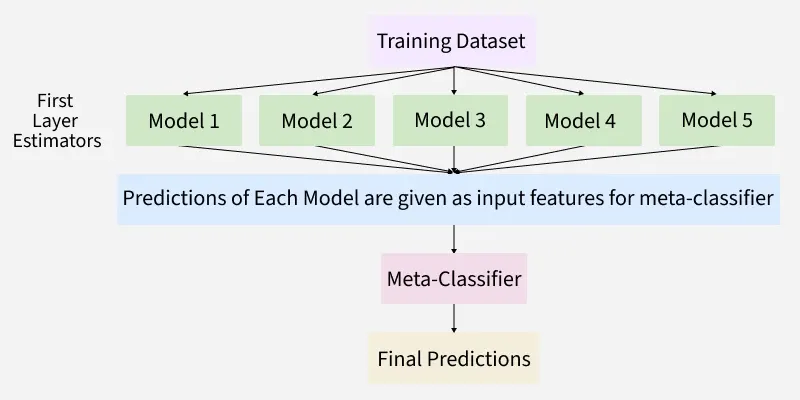
Stacking architecture is like a team of models working together in two layers to improve prediction accuracy. Each layer has a specific job and the process is designed to make the final result more accurate than any single model alone. It has two parts:
1. Base Models (Level-0)
These are the first models that directly learn from the original training data. You can think of them as the “helpers” that try to make predictions in their own way.
Base models can be Decision Tree, Logistic Regression, Random Forest, etc.
Each model is trained separately using the same training data.
2. Meta-Model (Level-1)
This is the final model that learns from the output of the base models instead of the raw data. Its job is to combine the base models predictions in a smart way to make the final prediction.
A simple Linear Regression or Logistic Regression can act as a meta-model.
It looks at the outputs of the base models and finds patterns in how they make mistakes or agree.
The process can be summarized in the following steps:
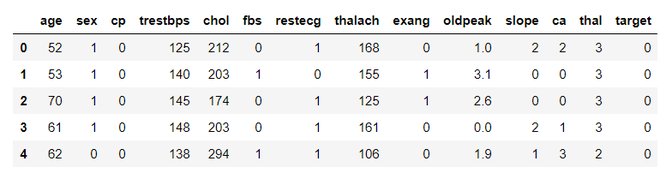
Start with training data: We begin with the usual training data that contains both input features and the target output.
Train base models: The base models are trained on this training data. Each model tries to make predictions based on what it learns.
Generate predictions: After training the base models make predictions on new data called validation data or out-of-fold data. These predictions are collected.
Train meta-model: The meta-model is trained using the predictions from the base models as new features. The target output stays the same and the meta-model learns how to combine the base model predictions.
Final prediction: When testing the base models make predictions on new, unseen data. These predictions are passed to the meta-model which then gives the final prediction.
With stacking we can improve our models performance and its accuracy.
Step 3: Splitting the Data into Training and Testing Sets
We will split the dataset into training and testing sets so we can train models and evaluate their performance.
train_test_split(): Splits data into train and test sets.
test_size = 0.2: Specifies that 20% of the data should be used for testing, leaving 80% for training.
random_state = 42: Ensures reproducibility by setting a fixed seed for random number generation.
Step 4: Standardizing the Data
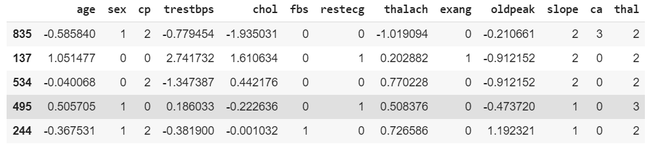
We will standardize numerical features so they have a mean of 0 and standard deviation of 1. This helps some models perform better.
StandardScaler(): Standardizes features.
fit_transform(): Learns scaling parameters from training data and applies them.
transform(): Applies learned scaling to test data.
var_transform: Specifies the list of feature columns that need to be standardized.
X_train[var_transform]: Applies the fit_transform method to standardize the selected columns in the training data.
X_test[var_transform]: Applies the transform method to standardize the corresponding columns in the test data using the scaling parameters from the training data.
KNeighborsClassifier(): A model based on nearest neighbors.
GaussianNB(): A Naive Bayes classifier assuming Gaussian distribution.
Step 6: Training and Evaluating KNeighborsClassifier
We will Train the KNN model and check its accuracy on the test set.
fit(): Trains the model.
predict(): Makes predictions on test data.
accuracy_score(): Calculates accuracy
Output:
Accuracy Score of KNeighbors Classifier: 86.88524590163934
Step 7: Training and Evaluating Naive Bayes Classifier
Similarly, we will train the Naive Bayes model and check its accuracy.
Output:
Accuracy of Naive Bayes Classifier: 86.88524590163934
Step 8: Implementing the Stacking Classifier
Now, we will combine the base models using a Stacking Classifier. The meta-model will be a logistic regression model which will take the predictions of KNN and Naive Bayes as input.
StackingClassifier(): Combines base models and a meta-model.
classifiers: List of base learners.
meta_classifier: Model that learns from base learners’ predictions.
use_probas=True: Passes probability outputs to the meta-model instead of class labels.
Step 9: Training Stacking Classifier
Next we will rain the stacking classifier and evaluate its accuracy.
Output:
Accuracy Score of Stacked Model: 88.52459016393442
Both individual models (KNN and Naive Bayes) achieved an accuracy of approximately 86.88%, while the stacked model achieved an accuracy of around 88.52%. This shows that combining the predictions of multiple models using stacking can slightly improve overall performance compared to using a single model.
Advantages of Stacking
Here are some of the key advantages of stacking:
Better Performance: Stacking often results in higher accuracy by combining predictions from multiple models making the final output more reliable.
Combines Different Models: It allow to use various types of models like decision trees, logistic regression, SVM made from each model’s unique strengths.
Reduces Overfitting: When implemented with proper cross-validation it can reduce the risk of overfitting by balancing out the weaknesses of individual models.
Learns from Mistakes: The meta-model is trained to recognize where base models go wrong and improves the final prediction by correcting those errors.
Customizable: We can choose any combination of base and meta-models depending on our dataset and problem type making it highly flexible.
Limitations of Stacking
Stacking also have some limitations as well:
Complex to Implement: Compared to simple models or even bagging or boosting, stacking requires more steps and careful setup.
Slow Training Time: Since you're training multiple models plus a meta-model it can be slow and computationally expensive.
Hard to Interpret: With multiple layers of models it becomes difficult to explain how the final prediction was made.
Risk of Overfitting: If the meta-model is too complex or if there's data leakage it can overfit the training data.
Needs More Data: It performs better when you have enough data, especially for training both base and meta-models effectively