Support Vector Regression (SVR) using Linear and Non-Linear Kernels in Scikit Learn
Last Updated : 20 Mar, 2026
Support Vector Regression predicts continuous values by fitting a function within a defined error margin. It uses kernel functions to handle both linear relationships and complex non-linear patterns in data.
Works well with high-dimensional data
Uses linear and kernel-based transformations
Controls model flexibility using regularization parameters
Effective for real-world datasets with limited samples
Linear Kernel SVR
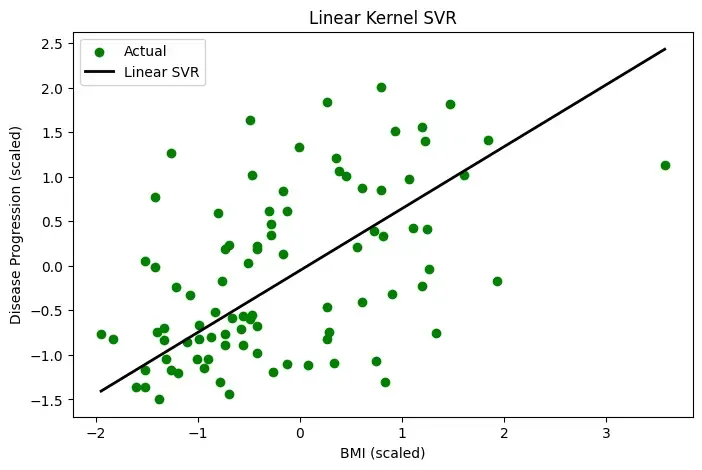
Linear SVR is used when the relationship between input features and the target variable is approximately linear. It fits a straight regression function in the original feature space without transforming the data into higher dimensions.
Kernel Function:
When to use
Data shows a linear trend
Large datasets with many features
Interpretability is important
Linear SVR is computationally efficient, interpretable and suitable for datasets where features have a direct and proportional relationship with the output.
Non-Linear Kernel SVR
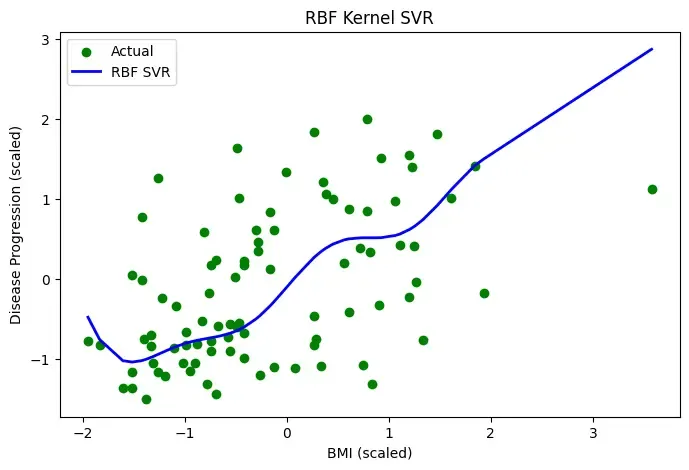
Non-linear SVR is applied when the relationship between input and output is complex and cannot be captured by a straight line. It uses kernel functions to implicitly map data into higher-dimensional spaces where a linear relationship can be learned.
This enables SVR to model curved patterns and complex feature interactions commonly found in real-world data.
Common Non-Linear Kernels
RBF (Gaussian) Kernel: The RBF kernel is the most widely used non-linear kernel in SVR. It measures similarity based on distance and allows the model to create smooth, flexible regression curves. It is highly effective for capturing localized and non-linear patterns.
Polynomial Kernel: The polynomial kernel models polynomial relationships between features and targets. It is useful when interactions between features follow polynomial behaviour but can become computationally expensive for higher degrees.
Sigmoid Kernel: The sigmoid kernel resembles neural network activation functions and is less commonly used in regression tasks due to stability issues.