Understanding Kernel Ridge Regression With Sklearn
Last Updated : 23 Jul, 2025
Kernel ridge regression (KRR) is a powerful technique in scikit-learn for tackling regression problems, particularly when dealing with non-linear relationships between features and the target variable. This technique allows for the modeling of complex, nonlinear relationships between variables, making it a valuable asset in data analysis.
This article delves into the inner workings of KRR, exploring its theoretical foundations, implementation details in scikit-learn, and practical considerations for effective use.
Kernel ridge regression is a variant of ridge regression that uses the kernel trick to learn a linear function in a high-dimensional feature space. This allows KRR to handle nonlinear data without the need for explicit transformation into a higher-dimensional space. The kernel trick is a mathematical technique that enables the computation of dot products in the high-dimensional feature space without explicitly mapping the data into that space. This is achieved by using a kernel function, which computes the dot product between two vectors in the high-dimensional space based on their original feature space representations.
Key Components of Kernel Ridge Regression:
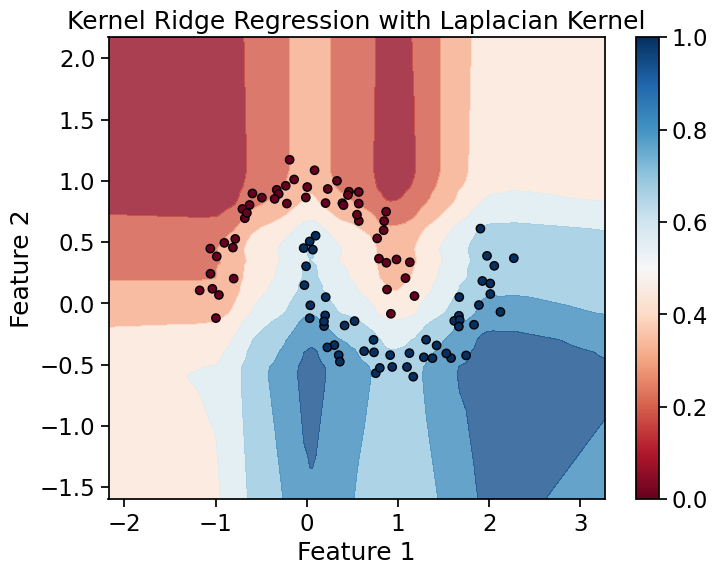
Kernel Functions: Kernel functions are the core of KRR. They define the similarity between data points in the high-dimensional feature space. Common kernel functions include the radial basis function (RBF), polynomial kernel, and sigmoid kernel. Each kernel function has its own strengths and weaknesses, and the choice of kernel depends on the specific problem and data characteristics.
Regularization: Regularization is a crucial aspect of KRR. It helps prevent overfitting by adding a penalty term to the loss function. The regularization strength is controlled by the alpha parameter, which determines the magnitude of the penalty.
Dual Coefficients: In KRR, the weights are not computed directly. Instead, the dual coefficients are calculated, which are the weights in the high-dimensional feature space. These coefficients are used to make predictions.
Implementing Kernel Ridge Regression with Scikit-Learn
Scikit-Learn provides an efficient implementation of KRR through the KernelRidge class. This class allows for easy creation and training of KRR models. The constructor of the KernelRidge class accepts several parameters, including the kernel function, regularization strength (alpha), and kernel parameters (e.g., gamma for RBF kernel).
Steps to Implement Kernel Ridge Regression:
Import Libraries: Start by loading the required libraries, these are from sklearn and other related libraries.
Load Dataset: Open the dataset you are going to use for solving the problem. Some of the datasets that are provided by Scikit-Learn for practice includes the following.
Preprocess Data: Before applying the logistic regression model, pre-Process your data; partitioning the data into training set and test set then normalize the independent variables.
Initialize KRR Model: Instantiate an object of Kernel Ridge Regression from sklearn.
Fit Model: This simply involves feeding the model to the training data available.
Make Predictions: From trained model, make predictions of the responses of the independent variables with respective to the dependent ones in the test data.
Evaluate Model: Evaluate the model using the correct measures that include Mean Squared Error (MSE).
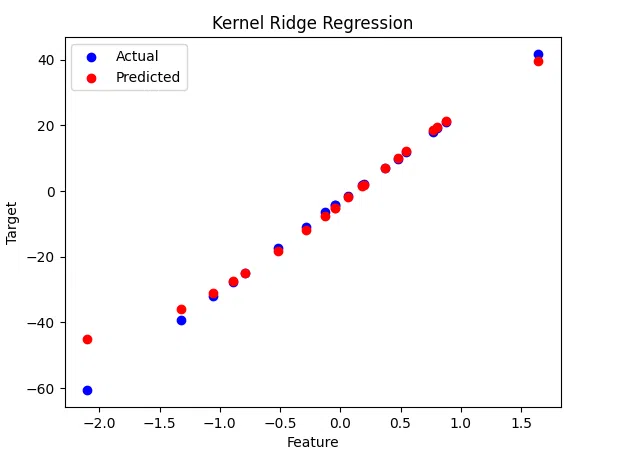
Let's walk through an example using a synthetic dataset.
Handling Large Datasets: Kernel Ridge Regression can be computationally expensive for large datasets due to the need to compute the kernel matrix. Techniques such as the Nyström method or random Fourier features can be used to approximate the kernel matrix and reduce computational complexity.
Regularization: Regularization is essential to prevent overfitting, especially when using complex kernels. The regularization parameter alpha controls the trade-off between fitting the training data and keeping the model weights small.
Kernel Selection: The choice of kernel significantly impacts the performance of the model. Experimenting with different kernels and their parameters is crucial to finding the best model for a given dataset.
Conclusion
Kernel Ridge Regression is a versatile and powerful regression technique that leverages the kernel trick to handle non-linear data. By combining the strengths of Ridge Regression and kernel methods, KRR provides a robust solution for complex regression tasks. With Scikit-Learn, implementing and tuning KRR models is straightforward, making it an excellent tool for data scientists and machine learning practitioners.