|
VOOZH | about |
|
VOOZH | about |
Factors are the numbers that divide the number exactly without leaving a remainder. Every number has a set of factors, which includes at least 1 and the number itself. We can find factors of a number using the multiplication method, division method, prime factorization, or factor pairs.
Factors of 16 are 1, 2, 4, 8, and 16.
In this article, we will learn about "Factors of 16", a list of factors of 16, the factor tree of 16, prime factors of 16, and some solved examples based on it.
Table of Content
Numbers that can divide another number without producing any remainder are known as factors.
For example, the factor of 12 are 1, 2, 3, 4, 6 and 12
16 has 5 factors 1, 2, 4, 8, and 16.
All the integers that divides by 16, without leaving any remainder are known as factors of 16. So, for this, we look at some examples.
So factors of 16 are 1, 2, 4 and 8 and 16 .
To obtain the prime factor of 16, here 16 is a composite number that has more than two factors. we must divide 16 by each prime number until we get the one. So, let's see the factors of 16 that start with the smallest prime number 2.
So, prime factors of 16 are 2 × 2 × 2 × 2 or 24
To determine the factors of 16, various methods will be used such as division, multiplication, and prime factorization. So, let's look at the factors of 16.
Using the division method, you divide 16 by the lowest prime numbers to begin finding the factors of 16, and you keep going until you run out of the last prime numbers in the factors of 16.
Thus, factors of 16 are, 1, 2, 4, 8, and 16
Using the multiplication method, you can pair up the factors and multiply them to obtain the original number (16) in order to find the factors of 16. So, Let's see the multiple pairs to get 16.
So, the pairs are (1, 16), (2, 8), and (4, 4) which are obtained by the multiplication method.
The prime factorization of 16 is expressed below in the following points;
So, At final we get the prime factor of 16, that is 2 × 2 × 2 × 2 or 24
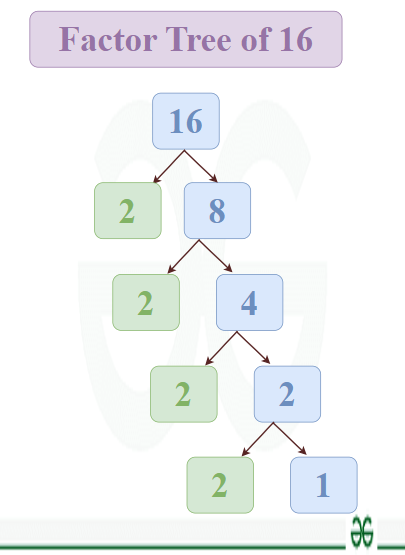
Factor tree is a graphical method used to break down a number into its prime factors. It visually represents the step-by-step process of dividing the original number by its prime factors until all the remaining factors are prime numbers. The step-by-step process to determine the Factor Tree of 16 is given below:
First, we divide by two to obtain eight. We repeat this procedure twice more.
Factor tree for 16 is illustrated below:
The integers that multiply together to create the initial number are known as factor pairs of 16. Even though, we will see them in positive pair factors and negative pair factors. So, Let's look after the factor pairs for 16 that are given below:
"Pair factors of Positive integers" can be found by multiplying the two integers in a pair by 16 to get the original number:
So, The positive pair factors of 16 are (1, 16), (2, 8), and (4, 4).
"Pair factors of negative integers" can be found by multiplying the two integers in a pair by 16 to get the original number:
So, The negative pair factors of 16 are (-1, -16), (-2, -8), and (-4, -4).
Read More,
Some examples of factor of 16 are,
Example 1: What is the sum of all the factors of 16?
Solution:
The factors of 16 are 1, 2, 4, 8, and 16.
Sum of the factors of 16 = 1 + 2 + 4 + 8 + 16
Sum of the factors of 16 = 31
Example 2: What are the common factors of 9 and 16?
Solution:
The common factor of given numbers 9 and 16 are given below;
9 = 1, 3, and 9
16 = 1, 2, 4, 8, and 16.
So, the common factors of 9 and 16 is only 1.
Example 3: Find the common factors of 64 and 16.
Solution:
The common factor of given numbers 64 and 16 are given below;
16 = 1, 2, 4, 8, and 16.
64 = 1, 2, 4, 8, 16, 32, and 64.
So, the common factors of 64 and 16 are 1, 2, 4, 8, and 16.
Example 4: Express 16 as the product of its prime factors.
Solution:
You can use prime factorization to express 16 as the product of its prime components.
As, 16 = 2 × 2 × 2 × 2
So, the prime factorization of 16 is 24
Various practice questions on factor of 16 are,
Q1: What is the product of the factors of 16?
Q2: Find the positive pair factors of 16.
Q3: What is the greatest common factor (GCF) of 16 and 24?
Q4: Is 3 a factor of 16?