|
VOOZH | about |
|
VOOZH | about |
In this article, we will learn dynamic data management in Postman through the use of variables. Postman, a substantially used API trying out and improvement device, gives a sturdy framework for growing, organizing, and executing API requests. Variables, as key components of Postman's capability, permit customers to inject flexibility, reusability, and adaptability into their workflows.
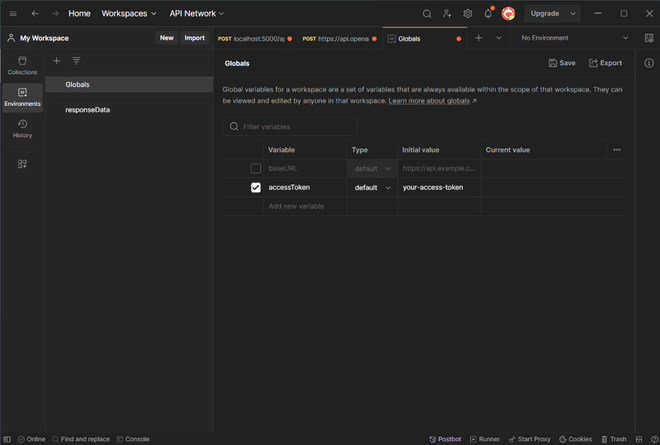
Variables in Postman function placeholders for dynamic statistics that can be reused for the duration of requests. They decorate flexibility, reusability, and maintainability in API testing and development. Variables in Postman can be defined at different levels: Global, Environment, and Local.
These are described at the global degree and persist at some point of all requests within Postman. They are beneficial for storing constants or records shared across various API calls.
Steps to dynamically manage data using variables in Postman:
Environment Variables:
Scoped to a selected surroundings, those variables permit you to manipulate sets of values for one-of-a-type testing or deployment situations. Environments can be switched without issues, converting the values of variables because of this. Follow the same steps as for global variables, but set variables specific to a particular environment.
Scoped to a particular request or script, nearby variables are useful for storing brief facts or calculations interior a specific API name.
Set variables within a specific request or script.
Variables are accessed the usage of the {{variableName}} syntax. This lets in for dynamic substitution of values in the path of the execution of a request.
URLs: Variables can be used in URLs to create dynamic endpoints or include parameters.
GET {{baseURL}}/users/{{userId}}
Headers: Variables are used to set dynamic values in headers.
Authorization: Bearer {{accessToken}}
Request Body: Use variables in the request body for dynamic data.
{
 "username": "{{username}}",
 "password": "{{password}}"
}
Pre-request Scripts: Scripts written in JavaScript may be used to dynamically generate or alter variables in advance than a request is sent. This allows for advanced customization primarily based on situations or calculations.
Variables can be applied at the collection level, allowing for centralized management. This is especially useful when organizing requests into logical groups or workflows.
Postman helps using CSV or JSON data files to store and manipulate sets of information. Variables can reference these external documents, permitting the testing of a couple of scenarios with exclusive input values.
Integration with CI/CD pipelines allows for the automation of testing workflows. Variables play a crucial role in adapting requests to various environments during automated testing.
By following these steps, you can efficiently use variables in Postman to create dynamic and flexible requests, making your testing and development workflows more robust and adaptable to different scenarios.