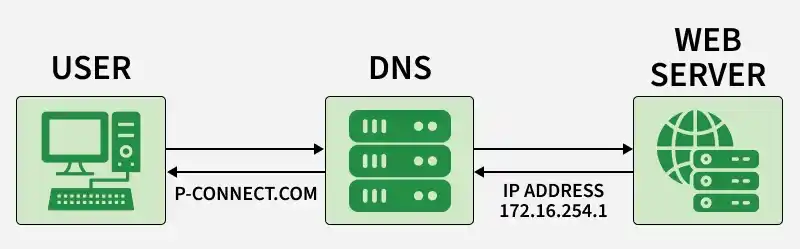
The Node.js DNS module provides methods for performing DNS lookups and working with domain names. It helps resolve domain names into IP addresses for network communication.
👁 user The DNS module is a core module in Node.js used for DNS-related operations. It allows resolving domain names to IP addresses and vice versa. It supports both synchronous and asynchronous DNS queries. Features The Node.js DNS module enables domain name resolution and DNS record queries.
DNS Lookup: dns.lookup() resolves a domain name to its corresponding IP address for network communication. Reverse DNS Lookup: dns.reverse() retrieves the domain name associated with a given IP address. DNS Record Queries: dns.resolve() and dns.resolve4() fetch DNS records such as A (IPv4) and AAAA (IPv6). Caching: Node.js caches DNS lookups to improve performance and reduce repeated queries. Error Handling: Provides mechanisms to handle errors during DNS resolution and related operations. Example 1: Print the IP address of GeeksforGeeks on the console.
Output:
address of geeksforgeeks.org is "52.25.109.230" family: IPv4 Example 2: Print the IP address of GeeksforGeeks and perform a reverse DNS lookup to find the associated hostname.
Output:
address: 52.222.176.140
reverse for 52.222.176.140: ["server-52-222-176-140.bom52.r.cloudfront.net"]
Benefits The Node.js DNS module enhances network operations by simplifying domain resolution and efficiently managing DNS queries.
Domain Name Resolution: Eliminates the need to memorize IP addresses by mapping domain names to corresponding IP addresses. Efficient Network Operations: Simplifies domain resolution and IP address management for network-based applications. Versatile DNS Queries: Supports multiple methods for querying and resolving different DNS records. Performance Optimization: DNS caching reduces repeated server queries and minimizes latency. Robust Error Handling: Provides mechanisms to detect and handle errors during DNS resolution operations. Also Check