|
VOOZH | about |
|
VOOZH | about |
The word science comes from the Latin verb " scientia." Science is a systematic understanding of all the natural phenomena in the universe. Using Science concepts, natural phenomena can be predicted, controlled, modified, and eradicated. It can be considered to be a global human endeavor, science is concerned with physical nature and its aspects. It includes imagination, experimentation, and deduction.
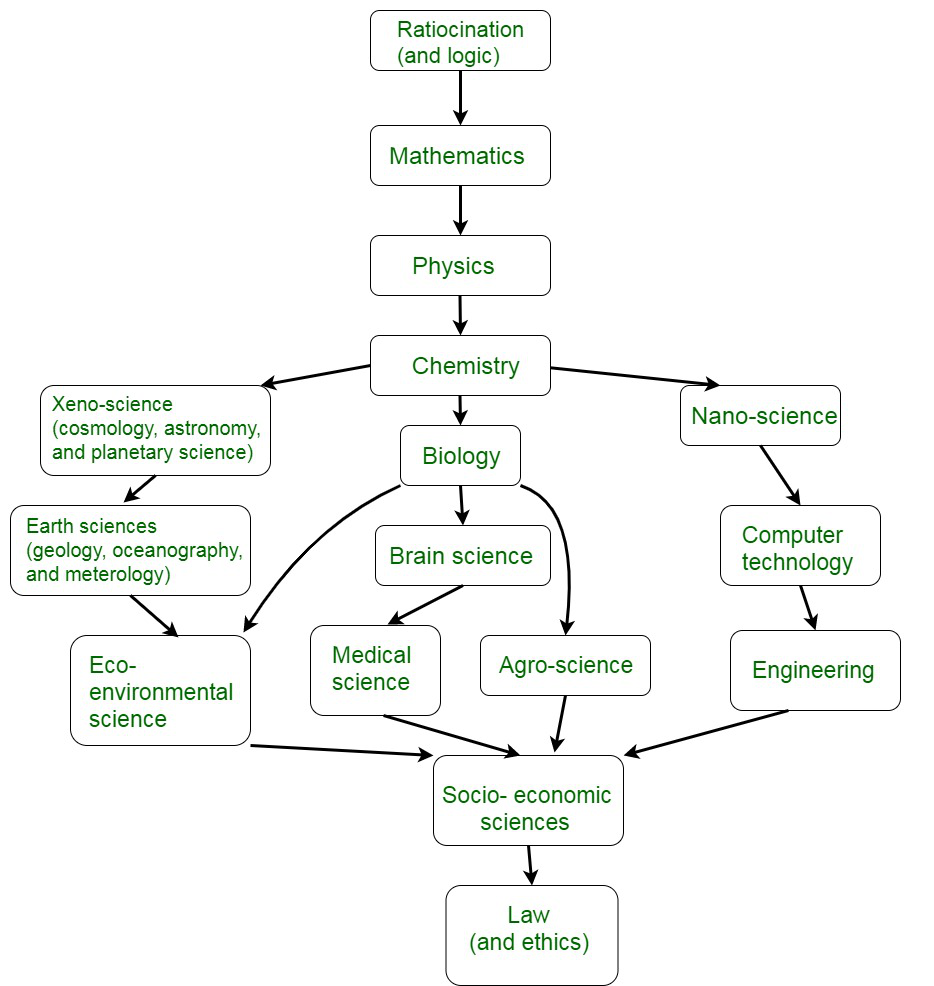
Knowledge about science has been gained by humans through experiments, observations, and trials conducted on the surrounding objects. Therefore, it is both knowledge and a process. The systematic and organized knowledge collected through various sources has formed a large pool, which is so vast today that it has been divided into many branches and sub-sections :
The science about study of studying inanimate natural objects is referred to as the physical sciences. It majorly includes the following branches:
The scientific study of life is referred to as the biological sciences:
Physics is the branch of science related to the study of basic laws of nature and their manifestations concerned with the different natural phenomena. It is also referred to as the "fundamental science" because it constrains all the other significant branches of the sciences. It can be considered to be the study of the physical world and matter along with its motion through space and time and also pertains to the concepts of energy and force as well.
Physics consist of two principal types of approaches :
⇒The scope of physics spreads over both massive objects like the universe and its surroundings, as well as to negligibly small-sized particles, like electrons, protons, etc.
⇒It is vast as it converts quantities with varying lengths stretching over a magnitude as high as 1060 m (study of the universe) or as low as 10-12 m (study of electrons, protons, etc).
⇒It also encompasses a wide range of masses from minutely small, like protons, neutrons etc., 10-10 kg, to highly massive galaxies, 1080 kg, physics considers both the microscopic and macroscopic domains.
Physics is divided into two major categories based on its scope:
The branch of physics dealing with the movement of physical objects, more specifically the relationships between force, matter, and motion associated between them. It takes into consideration the objects both at rest and in motion.
The branch of physics dealing with rapidly changing electric and magnetic fields. It also pertains to the understanding of the particle motion and interactions produced within the variable fields. Maxwell devised numerous laws that are concerned with the motion of electric fields and their attributes.
The branch of physics dealing with the behavior and the interactions of light with each other. It can be used to simulate the construction of devices used to visualize and detect the aspects and components of light. It takes into account both ray and wave optics. It involves concepts related to the formation of images and the working of topics of reflection, refraction as well as diffraction.
The branch of physics related to heat and energy and its involved concepts. It also described the relationship with radiation along with the physical properties of matter. It also includes the conversion of heat into different types of energy; mechanical or electrical energy.
Physics is a very significant branch of science that plays a crucial role in understanding the developments pertaining to the other branches of science, such as Chemistry, Biology, etc.
The study of physical variables involved in the study of mathematics has led to the discovery of ideas of differentiation, integration, and differential equations involved in the estimation of quantities. Theories in physics and derivations in mathematics coexist with each other. Math is considered to be a deterministic tool for the development of modern theoretical physics. It provides a way to formulate and evaluate experimental results.
Mathematics | Physics | |
| Graph | Represents a single object. | Represents a relationship between two quantities. |
| Axes | Dimensionless numbers are represented by linear scaling | Values of quantities are expressed in some units. Scaling may be linear or non-linear. |
| Origin | (0,0) | Any arbitrary position. |
| Plot range | infinite | The ranges of the quantities. |
| Slope Gradient | Dimensionless numbers have a geometric interpretation only. | Change of one quantity with respect to another. |
Physics form the essence of the field of biology. The concepts and illustrations of space, time, and matter have induced a better understanding of the existence of living organisms and the study of the laws of conversation of energy. Many diseases and ailments have been better diagnosed over the years due to developments in physics and vice versa. Disease diagnosis has been very efficient due to X-ray invention and practices.
Chemistry is basically an extension of Physics. The concepts associated with X-ray diffraction and radioactivity have revolutionized the study of the periodic table. The intra-particle forces, as well as internal interactions, can also be used to get a better insight into the bonding and the chemical structure of substances. The structure, behavior, and properties of matter are both easily understood with both the branches existing together.
Meteorology holds an explicit part in the discipline of physics. It tends to explain nature's observed behavior through estimated hypotheses and conjectures while taking into consideration the various relativistic repercussions. Atmospheric physics and meteorology use both mathematical and physical models to understand the weather and climatic conditions. It also relates to the descriptive mathematical and computer modeling of atmospheric dynamics.
The branch of astronomy is considered to be applied physics since it applies the scientific hypotheses and basic rules of physics to further the understanding of the celestial bodies and universe.For instance, the discovery and usage of radio telescopes, as well as optical telescopes, have stipulated an easy way to explore the universe.
Type of forces | Governs |
All objects in the universe | |
Weak nuclear force | Particularly electrons and neutrinos. |
Charged particles | |
Strong nuclear force | Nucleons, heavier elementary particles |
Related Reads,