|
VOOZH | about |
|
VOOZH | about |
The STRING_AGG() function in PostgreSQL is a powerful aggregate function used to concatenate a list of strings with a specified separator. This function is essential for combining string values from multiple rows into a single string, making data aggregation more efficient and readable.
Let us get a better understanding of the syntax, usage, and practical examples of the STRING_AGG() function in PostgreSQL, using the sample database dvdrental.
STRING_AGG ( expression, separator [ORDER BY clause] )Now let's look into some examples. For examples, we will be using the sample database (ie, dvdrental).
Example 1: Listing Actor Names for Each Film
We want to generate a list of actor names for each film, separated by commas. Here’s the query:
Query:
SELECT
 f.title,
 STRING_AGG (
 a.first_name || ' ' || a.last_name,
 ', '
ORDER BY
 a.first_name,
 a.last_name
 ) AS actors
FROM
 film f
INNERJOIN film_actor fa USING (film_id)
INNER JOIN actor a USING (actor_id)
GROUP BY
 f.title;
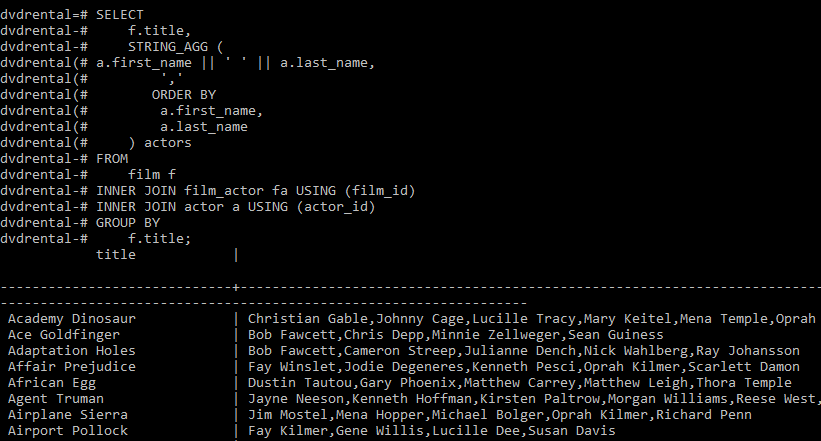
Output:
👁 Example 1: OutputExplanation: This query concatenates actor names for each film, separated by commas and ordered alphabetically by first name and last name.
In this example, we will create an email list for each country, with emails separated by a semicolon. Here’s the query:
Query:
SELECT
 country,
 STRING_AGG (email, ';') email_list
FROM
 customer
INNER JOIN address USING (address_id)
INNER JOIN city USING (city_id)
INNER JOIN country USING (country_id)
GROUPBY
 country
ORDERBY
 country;
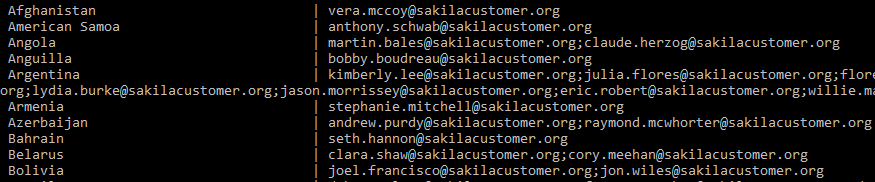
Output:
👁 Example 2: OutputExplanation: This query generates a semicolon-separated list of emails for each country, ordered by country name.
- The PostgreSQL STRING_AGG() function is used to concatenate a list of strings into a single string with a specified separator.
- STRING_AGG() ignores NULL values in the concatenation process, ensuring that only non-NULL strings are included in the final result.
- Commonly used with GROUP BY to aggregate data and produce concatenated string results for grouped rows.
- STRING_AGG() Function can be combined with other PostgreSQL functions like COALESCE to handle NULL values or FORMAT to format the output string.