|
VOOZH | about |
|
VOOZH | about |
A PostgreSQL trigger is a powerful tool that allows automatic invocation of a function whenever a specified event occurs on a table. Events that can trigger a function include INSERT, UPDATE, DELETE, or TRUNCATE. Triggers help maintain data integrity and automate complex database operations.
A trigger is a special user-defined function associated with a table. To create a new trigger, you must define a trigger function first, and then bind this trigger function to a table. The difference between a trigger and a user-defined function is that a trigger is automatically invoked when an event occurs.
PostgreSQL provides two main types of triggers:
UPDATE' statement affecting 20 rows will invoke the row-level trigger 20 times.Also Read: Difference between Row level and Statement level triggers.
Triggers can be specified to fire before or after the event:
Triggers offer several benefits:
While triggers are powerful, they also have some drawbacks:
TRUNCATE event.Let’s take a look at an example of creating a new trigger in PostgreSQL to better understand the concept.
In this example, we will create a new table named 'employees' as follows:
CREATE TABLE COMPANY(
 ID INT PRIMARY KEY NOT NULL,
 NAME TEXT NOT NULL,
 AGE INT NOT NULL,
 ADDRESS CHAR(50),
 SALARY REAL
);
When the name of an employee changes, we log the changes in a separate table named 'employee_audits':
CREATE TABLE AUDIT(
 EMP_ID INT NOT NULL,
 ENTRY_DATE TEXT NOT NULL
);
First, define a new function called auditlog():
CREATE OR REPLACE FUNCTION auditlog() RETURNSTRIGGER AS $$
BEGIN
INSERT INTO AUDIT(EMP_ID, ENTRY_DATE) VALUES (NEW.ID, current_timestamp);
RETURN NEW;
END;
$$ LANGUAGE plpgsql;
We create a trigger named 'example_trigger' that fires after an 'INSERT' event on the 'COMPANY' table:
CREATE TRIGGER example_trigger
AFTER INSERT ON COMPANY
FOR EACH ROW
EXECUTE FUNCTION auditlog();
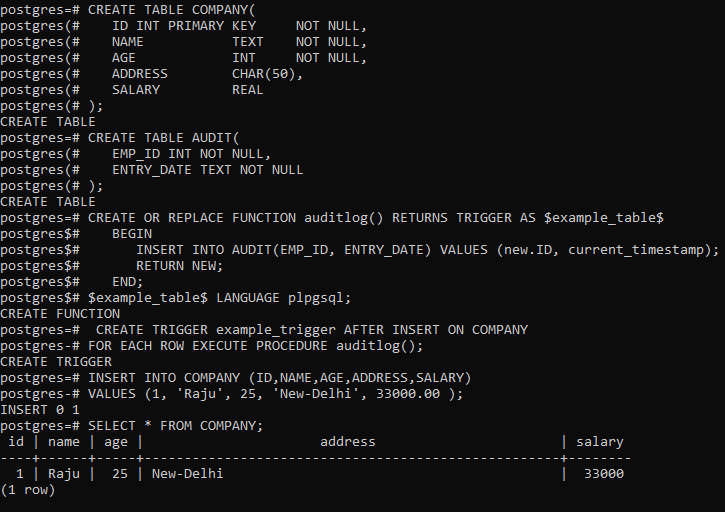
Insert some sample data for testing. We insert two rows into the employees table.
INSERT INTO COMPANY (ID, NAME, AGE, ADDRESS, SALARY)
VALUES (1, 'Raju', 25, 'New-Delhi', 33000.00 );
To examine the employees table use the below query:
SELECT * FROM COMPANY;
Output:
👁 Image
- Unlike many other SQL databases, PostgreSQL supports triggers on the
TRUNCATEevent.- PostgreSQL allows you to define statement-level triggers on views, enabling complex data manipulations and validations even when using views.
- PostgreSQL allows multiple triggers on the same event. However, the execution order is not guaranteed unless explicitly set using the
BEFOREorAFTERkeywords.- PostgreSQL has a powerful rule system that can be used in conjunction with triggers. Rules can transform incoming queries before they reach the execution phase, while triggers act on data changes.